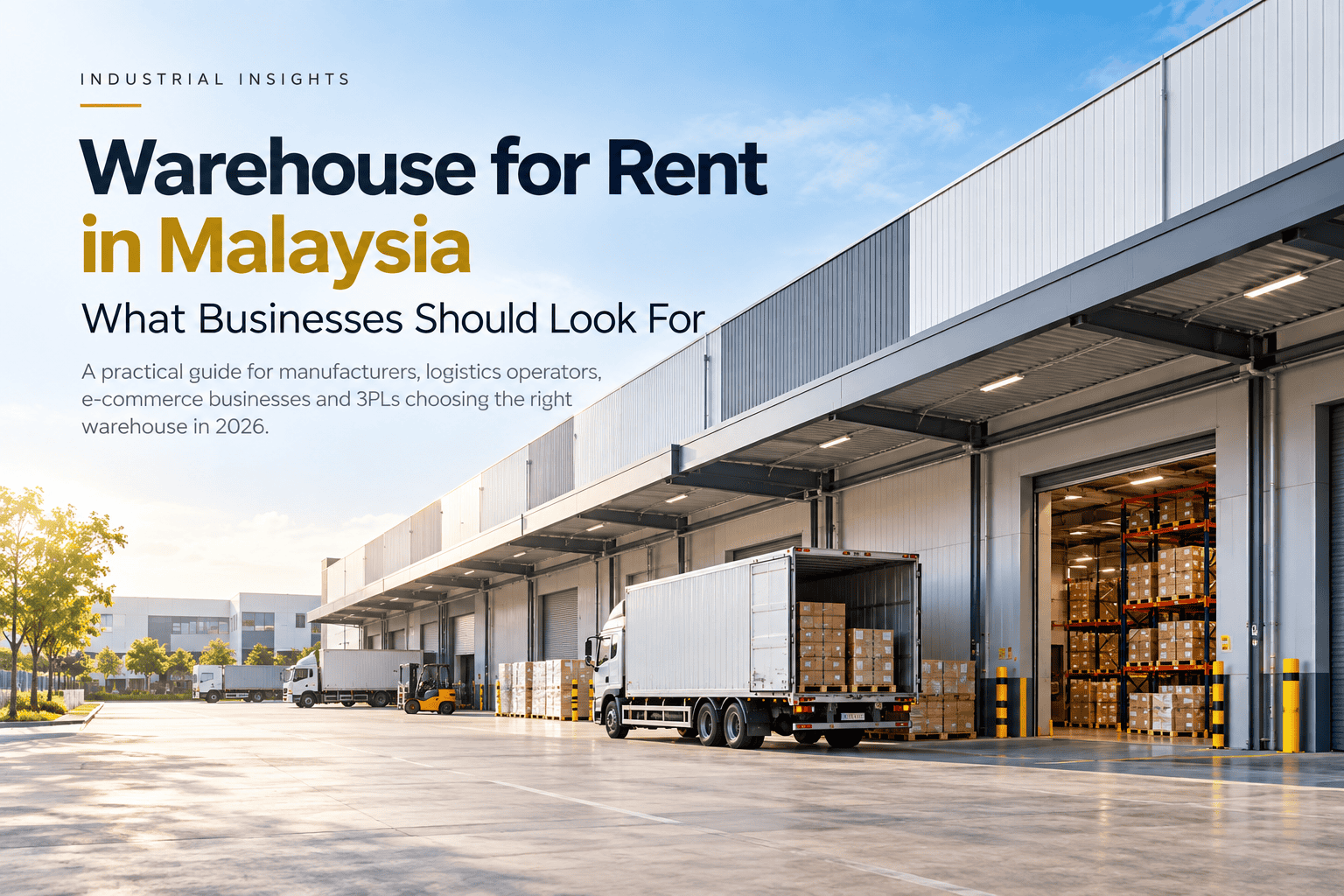
A practical guide for manufacturers, logistics operators, e commerce businesses and 3PLs choosing the right warehouse in 2026.
Introduction
Renting a warehouse is one of the most important operational decisions a growing business makes. Whether you are expanding an e commerce fulfilment operation, setting up a distribution centre, supporting manufacturing activities or simply adding storage capacity, the warehouse you choose can directly affect efficiency, logistics costs and future growth.
The problem is that not all warehouses are equal.
Two warehouses with similar floor areas and rental rates can perform very differently once you consider ceiling height, floor loading, loading access, power supply, yard space and location.
A cheaper warehouse in the wrong location, or one without the right specifications, may eventually cost more through additional transport expenses, inefficient storage or operational limitations.
So what should businesses actually look for when searching for a warehouse for rent in Malaysia?
The answer goes beyond rental rate. Businesses should assess how well the property supports their actual operations today and whether it can continue supporting them as the business grows.
What Should You Look for When Renting a Warehouse in Malaysia?
The most important factors normally include:
- Location and highway connectivity
- Clear ceiling height
- Floor loading capacity
- Loading and unloading facilities
- Power supply
- Yard and container access
- Fire safety and building compliance
- Office and staff facilities
- Rental and lease terms
The importance of each factor depends on how the warehouse will be used. A conventional storage operator, an e commerce fulfilment centre, a cold chain operator and a manufacturer may all have very different property requirements.
1. Location and Highway Connectivity
For a warehouse, location is less about prestige and more about logistics efficiency.
Every additional kilometre between your warehouse and your customers, suppliers, factories, ports or distribution points can affect transport time and cost.
The Klang Valley is one of Malaysia’s main industrial and logistics markets because of its large population catchment, established industrial areas and extensive highway network.
Major warehouse and logistics locations include Port Klang, Klang, Bandar Bukit Raja, Shah Alam, Subang and surrounding industrial corridors.
Depending on the location, businesses may have access to major highways such as the NKVE, ELITE, SKVE and KESAS.
When assessing a warehouse location, ask:
- How far is the warehouse from your major customers and suppliers?
- How convenient is access to Port Klang, airports or other distribution points?
- How quickly can vehicles reach the major highway network?
- What is traffic like during peak operating hours?
- Can 40 foot containers, prime movers and other heavy vehicles access the property easily?
For businesses serving southern Malaysia or Singapore, Johor is another major industrial and logistics market. Penang and the northern region are particularly relevant to businesses connected to the manufacturing, electrical and electronics and supply chain sectors.
The best warehouse location therefore depends on where your goods come from, where they need to go and how frequently they move.
2. What Ceiling Height Does Your Warehouse Need?
Clear ceiling height is one of the most important warehouse specifications, especially for businesses using pallet racking.
Clear height refers to the usable vertical distance between the warehouse floor and the lowest overhead obstruction.
Modern logistics facilities may provide clear heights of around 10 to 12 metres or more, depending on the building design. Older warehouses may have considerably lower usable heights.
Why does this matter?
A taller warehouse can allow higher racking systems and more pallet positions within the same floor area.
For businesses that rely heavily on storage density, judging a warehouse purely by square footage can therefore be misleading.
A smaller warehouse with greater usable height may sometimes accommodate more inventory than a larger warehouse with a low ceiling.
Businesses planning to install high bay racking should confirm the actual clear height rather than relying only on the overall building height.
3. How Important Is Floor Loading Capacity?
The warehouse floor must be capable of supporting the combined weight of inventory, racking systems, forklifts, machinery and other equipment.
Floor loading capacity is normally expressed in tonnes per square metre.
The required capacity varies according to the type of operation.
Businesses storing dense or heavy products, installing tall pallet racking or using heavy equipment may require substantially stronger floor specifications than businesses storing lightweight goods.
Before committing to a warehouse, ask for the available building specifications and confirm whether the floor loading capacity is suitable for your intended operation.
For operations involving particularly heavy loads, professional engineering advice may be appropriate.
It is also wise to think beyond your current requirement. If your inventory volume or racking system is expected to grow, the warehouse should ideally be able to support that expansion.
4. Loading Bays and Dock Levellers
A warehouse can offer excellent storage space but still perform poorly if vehicles cannot load and unload efficiently.
Malaysia’s Ministry of Transport warehouse guidance recognises loading and unloading areas as an important part of warehouse workflow.
When inspecting a warehouse, look at:
- The number and position of loading bays
- Raised loading docks or ground level loading
- Availability of dock levellers
- Vehicle waiting and staging areas
- Internal circulation
- Truck turning and manoeuvring space
- Access for the largest vehicles used by your business
There is no single loading bay ratio that is suitable for every warehouse.
The number of loading positions required depends on factors such as the volume and frequency of deliveries, type of cargo, vehicle type, loading method and handling equipment.
A high throughput distribution or fulfilment operation may require significantly more loading capacity than a conventional storage warehouse.
Dock levellers can also improve efficiency where raised loading docks are provided by helping bridge the difference between the loading platform and vehicle.
The important question is not simply how many loading bays a warehouse has, but whether the loading arrangement matches your actual movement of goods.
5. How Much Power Supply Does a Warehouse Need?
Power supply is becoming increasingly important as warehouse operations become more sophisticated.
A conventional storage warehouse may require relatively modest electricity capacity.
However, operations involving cold storage, conveyor systems, automated storage systems, material handling equipment, processing machinery or electric vehicle charging can require substantially higher capacity.
Before renting a warehouse, confirm the existing electrical supply and compare it with your operational requirements.
Also ask:
- Is the existing supply sufficient for your equipment?
- Is additional power capacity available if the business expands?
- Will upgrading the supply require approval or additional infrastructure?
- Who will bear the cost of any upgrade?
An underpowered warehouse can limit future automation or expansion.
Rather than assuming a certain amp supply automatically makes a warehouse high specification, businesses should assess power based on their actual operating needs.
6. Yard Space and Container Access
For some businesses, the space outside the warehouse is almost as important as the building itself.
A good yard can provide room for:
- Container parking
- Trailer staging
- Vehicle circulation
- Temporary loading activity
- Fleet parking
- Operational overflow
Businesses that regularly receive containers should pay particular attention to the entrance width, road condition, turning radius and manoeuvring space.
A warehouse may appear large on paper, but inadequate external space can create serious congestion once several trucks arrive at the same time.
Yard space may be included within the overall rental or charged separately depending on the property and lease structure.
7. Fire Safety, CCC and Permitted Use
Compliance should be checked before committing to a warehouse.
Important matters include fire protection, building approval and whether the intended operation is permitted at the property.
Fire Safety
Check the fire protection systems available within the building, which may include:
- Sprinklers
- Fire hydrants
- Fire alarms
- Hose reels
- Fire extinguishers
- Emergency exits
Under Malaysia’s Fire Services Act 1988, premises classified as designated premises are required to hold a Fire Certificate.
Businesses should therefore confirm whether the warehouse falls within the applicable requirements and whether additional Bomba requirements apply to the intended operation.
Certificate of Completion and Compliance
Check whether the property has the relevant Certificate of Completion and Compliance, commonly known as CCC.
The CCC is an important document confirming that the building has fulfilled the relevant completion and compliance requirements.
Permitted Use
Businesses should also verify that the property and relevant planning approvals are suitable for the intended activity.
Certain operations may be subject to additional requirements depending on the nature of the goods stored or activities carried out.
Examples may include food related operations, chemicals, hazardous materials, cold storage or manufacturing related activities.
Do not assume that because a building looks like a warehouse, every type of business activity can automatically operate there.
8. Check the Building Condition
The physical condition of the property can significantly affect future maintenance and operating costs.
During inspection, look for:
- Roof leaks or signs of water intrusion
- Cracks in the warehouse floor
- Drainage problems
- Damaged roller shutters
- Condition of loading areas
- Lighting and ventilation
- General structural condition
- Signs of previous repairs
For larger or older warehouses, businesses may consider obtaining professional advice if there are concerns about the building structure or condition.
Finding defects before signing the tenancy agreement is much easier than dealing with them after moving in.
9. Office and Staff Facilities
Most warehouse operations need more than storage space.
Depending on the business, you may require offices for administration, operations teams, customer service, security or management.
Check whether the property provides suitable:
- Office space
- Toilets
- Pantry facilities
- Staff areas
- Guardhouse
- Parking
- Meeting space
- Internet and telecommunications infrastructure
If significant renovation is required, factor the fit out cost into your overall occupancy budget.
A warehouse with slightly higher rent but usable office facilities may sometimes be more economical than a cheaper property requiring extensive renovation.
10. How Much Does It Cost to Rent a Warehouse in Malaysia in 2026?
Warehouse rental rates in Malaysia vary considerably according to location, size, building age, specification, clear height, floor loading, loading facilities and overall condition.
There is therefore no single rental rate that applies to every warehouse.
As a useful market reference, JLL reported that gross rent in the Greater Kuala Lumpur prime logistics market stood at approximately RM2.19 per square foot per month in Q2 2026.
JLL also reported that leasing activity was concentrated in Grade A facilities, with occupiers showing stronger interest in modern specifications and strategic locations.
This figure should not be interpreted as the rental rate for every warehouse in Klang Valley.
Older conventional warehouses, larger standalone facilities and properties in different industrial locations may transact or be offered at different rental levels. Modern logistics facilities with stronger specifications may also command a premium.
Businesses should therefore compare more than the headline rental rate.
A warehouse that costs slightly more but offers greater storage density, better loading efficiency and a stronger location may result in a lower overall operating cost.
For Johor, Penang and other Malaysian warehouse markets, rental levels should similarly be assessed based on the individual location, building specifications and prevailing market conditions.
11. What Lease Terms Should Businesses Check?
Once you have found a suitable warehouse, the tenancy terms are just as important as the building itself.
Important areas to review include:
Lease Period and Renewal
Consider whether the tenancy period matches your business plans, particularly if you will be investing heavily in racking, automation, cold rooms or other fit out works.
Rental Revision
Understand whether the rent changes during the tenancy period or upon renewal.
Deposits
Check the security deposit, utility deposit and any other payments required before occupation.
Maintenance Responsibilities
Clearly establish who is responsible for structural repairs, roof repairs, equipment, common areas and other maintenance matters.
Fit Out Rights
Confirm whether the landlord allows the installation of racking, cold rooms, machinery, electrical upgrades or automation systems.
Also understand what must be removed or reinstated when the tenancy ends.
Termination and Renewal Conditions
Review what happens if the business needs to leave before expiry and how renewal terms will be determined.
A favourable rental rate combined with unsuitable lease conditions may not represent a good deal.
Businesses should review the tenancy agreement carefully before committing.
Common Mistakes When Renting a Warehouse
Judging the Warehouse by Floor Area Alone
Square footage does not tell the full story.
Clear height, building layout and floor loading can significantly affect usable storage capacity.
Underestimating Future Power Requirements
Power that is sufficient today may become inadequate when the business introduces automation, cold storage or additional equipment.
Ignoring Loading Access
A warehouse is only efficient if goods can move in and out smoothly.
Poor truck access and insufficient manoeuvring space can create daily operational problems.
Overlooking Compliance
CCC, fire safety requirements, planning approvals and permitted use should be checked before occupation.
Choosing Based Only on Rental Rate
The cheapest warehouse is not necessarily the lowest cost warehouse.
Transport costs, inefficient storage, labour movement and loading delays can quickly outweigh rental savings.
Not Planning for Growth
Moving a warehouse is expensive and disruptive.
If possible, consider whether the property can accommodate your expected inventory, workforce and operational requirements over the next few years.
Frequently Asked Questions
What should I check before renting a warehouse in Malaysia?
Businesses should check location, truck access, clear ceiling height, floor loading, loading facilities, power supply, yard space, building condition, CCC, applicable fire safety requirements and tenancy terms.
The exact priorities will depend on the type of business and goods being handled.
What is a good ceiling height for a warehouse?
There is no single ideal ceiling height.
Modern logistics facilities may provide clear heights of around 10 to 12 metres or more, while older warehouses may be lower.
Businesses using high racking systems will generally benefit more from greater clear height.
How much is warehouse rental in Klang Valley in 2026?
Rental rates vary significantly by location and specification.
As a market reference, JLL reported gross rents of approximately RM2.19 per square foot per month for the Greater Kuala Lumpur prime logistics market in Q2 2026.
Individual warehouse asking rents may be lower or higher depending on property type, size, age, location and specifications.
Which areas are popular for warehouse rental in Klang Valley?
Major warehouse and industrial locations include Port Klang, Klang, Bandar Bukit Raja, Shah Alam, Subang and other established industrial corridors across Selangor and Greater Kuala Lumpur.
The best location depends on the business’s customers, suppliers, ports and distribution network.
Does every warehouse need a Bomba Fire Certificate?
Not necessarily.
Under Malaysia’s Fire Services Act 1988, a Fire Certificate is required for designated premises.
Businesses should check whether the particular building falls within the applicable requirements and whether other fire safety approvals or requirements apply to their intended use.
Should I choose the cheapest warehouse available?
Not always.
A slightly higher rental may provide better highway access, higher storage capacity, stronger loading facilities or better power supply.
The better comparison is often the total cost and efficiency of operating from the warehouse rather than rental rate alone.
Choosing the Right Warehouse for Your Business
Choosing a warehouse for rent in Malaysia should start with your operation, not simply the rental rate.
Understand how goods enter the warehouse, how they are stored, how frequently they leave, what equipment you use and how the business is expected to grow.
A suitable warehouse should support those requirements without creating unnecessary operational restrictions.
For manufacturers, logistics companies, e commerce operators, distributors and 3PL businesses, factors such as location, ceiling height, floor strength, truck access, power supply and compliance can ultimately be more important than obtaining the lowest rental rate.
The right warehouse is not simply a place to store goods.
It is part of your supply chain infrastructure, and choosing it carefully can improve efficiency, support future growth and reduce avoidable operating costs.