
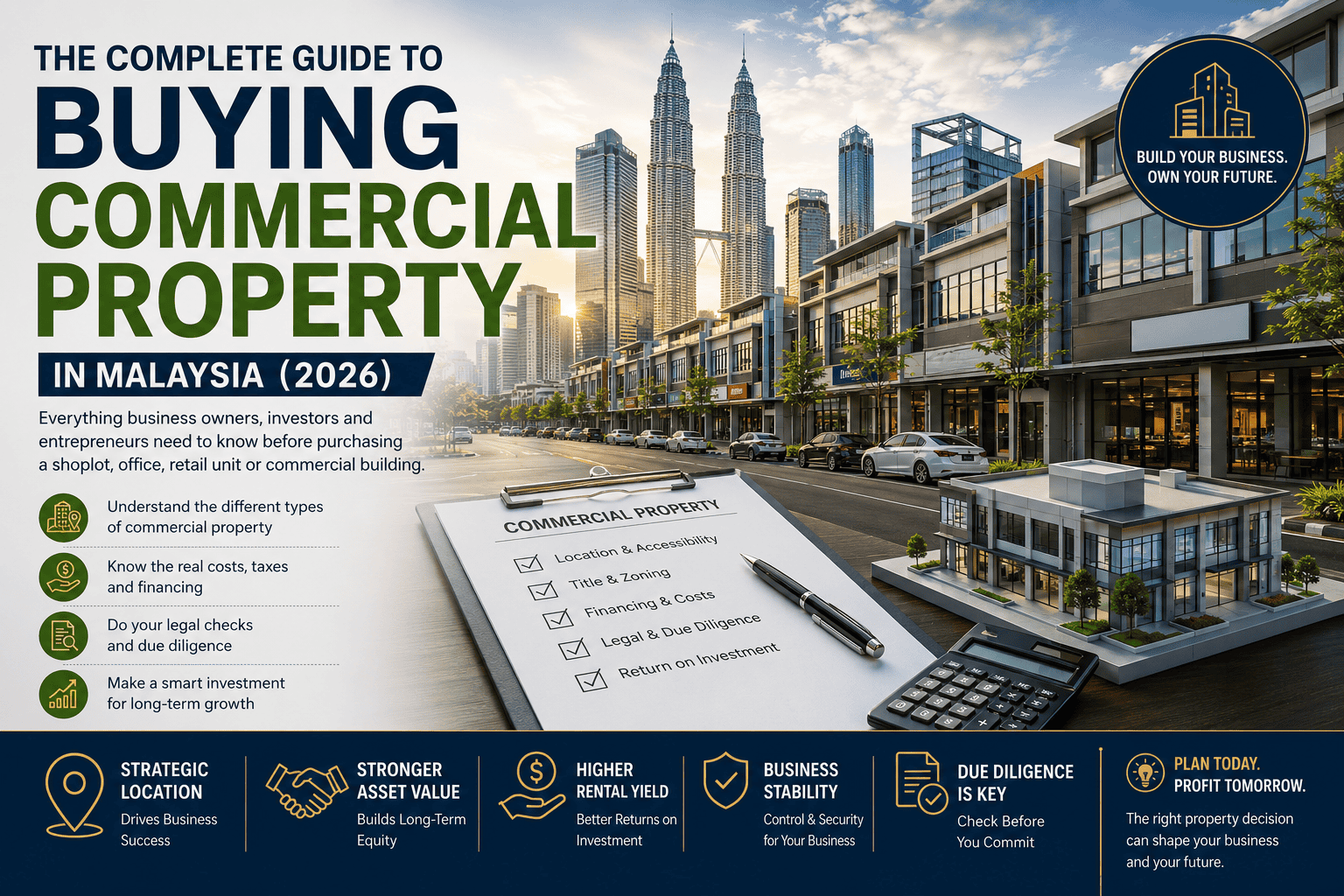
Everything business owners, investors and entrepreneurs need to know before purchasing a shoplot, office, retail unit or commercial building.
What Count as Commercial Property in Malaysia
Commercial property is any property zoned and titled for business use rather than for living in. The land title itself will typically state a commercial category, and this is what determines what you can legally do with the property.
Common examples include shoplots, office units and office buildings, retail lots in malls and commercial centres, shophouses, and commercial land. Certain mixed-use developments also fall under commercial titles even when they look residential, which is an important point we return to below.
Commercial vs Residential: Why the Distinction Matters
Many first-time buyers assume property is property. In reality, whether a unit carries a commercial or residential title changes almost everything about the transaction:
I’d smooth it like this:
Financing.
Banks generally offer lower financing margins for commercial property compared with residential property. While residential financing may reach up to 90% depending on the buyer’s profile and the number of properties already owned, commercial financing generally ranges from around 80% to 90% for owner occupiers and may be lower for investment purchases. Ultimately, the financing margin depends largely on the buyer’s financial profile, the property and the bank’s lending criteria.
Loan tenure.
Commercial loan tenures are usually shorter than residential ones, which raises the monthly instalment for the same borrowed amount.
Utilities and assessment.
Commercial properties are charged commercial rates for electricity, water and local council assessment — higher than residential rates.
Tax on rental income.
Rental income from both commercial and residential property is generally taxable in Malaysia. Certain expenses incurred in producing the rental income may be deductible, subject to applicable tax rules. In addition, rental of commercial property may be subject to Service Tax under Malaysia’s SST rules. From 1 January 2026, the Service Tax rate on rental or leasing services is 6%. Eligible MSME tenants with annual sales of up to RM1.5 million may qualify for an exemption, subject to the applicable conditions.
Understanding which side of the line your property sits on is the first step of any commercial purchase, because it shapes your entire budget.
Types of Commercial Property
Choosing the right type depends on your business operations, your investment goals and your budget.
Shoplots and shophouses remain the backbone of Malaysian commercial property — versatile, widely available, and suitable for retail, F&B, services and light business operations. Ground-floor units command a premium for their frontage and footfall.
Office units and office buildings suit service-based businesses and companies needing a professional address. Strata offices in commercial towers are common in urban centres.
Retail lots inside malls and commercial hubs offer built-in footfall but come with service charges and, often, tenancy conditions set by the mall management.
Commercial land offers the most flexibility for businesses planning to build to their own specification, though it carries the added complexity of development approvals.
Why Buy Commercial Property
For a business, buying rather than renting converts a recurring cost into an owned asset. Instead of rental payments disappearing every month, you build equity in property that can appreciate over time. Ownership also gives you control — no landlord deciding whether to renew your tenancy, raise your rent, or sell the building out from under you.
For investors, commercial property typically offers higher rental yields than residential, and commercial tenants often sign longer leases, providing more stable income. Businesses also tend to maintain the premises they operate from, reducing the wear-and-tear headaches associated with residential tenants.
Step-by-step: The Buying Process
- Define your requirements. Before viewing anything, be clear on what you need — location, size, floor loading if relevant, parking, frontage, and whether the title use matches your intended business activity.
- Get your financing indication. Speak to banks early to understand how much you can borrow and at what margin. Commercial financing is more conservative, so knowing your real budget upfront prevents wasted time.
- Shortlist and view. Assess each property against your requirements and, critically, against its surroundings — access, visibility, footfall and the health of the neighbouring businesses.
- Make an offer and pay the earnest deposit. Once the price and key terms are agreed, the buyer usually signs a Letter of Offer and pays an earnest deposit, commonly 3% of the purchase price. This amount normally forms part of the total deposit payable for the purchase, subject to the agreed terms.
- Secure your loan and complete legal documentation. The bank finalises the loan, the loan agreement is signed, and stamp duty is settled.
- Sign the Sale and Purchase Agreement (SPA). Your lawyer prepares or reviews the SPA. You typically pay the balance of the 10% down payment at this stage.
- Transfer of ownership. The Memorandum of Transfer (MOT) is stamped and lodged for registration, and ownership is transferred to the buyer. For a straightforward transaction, completion commonly takes around 3 months for a freehold property, while a leasehold property may take around 4 to 6 months where State Authority consent or other approvals are required. Actual timelines may vary depending on the transaction, financing and documentation.
True Cost of Buying: 2026 Figures
The purchase price is only part of what you pay. Budgeting for the full acquisition cost is where many buyers slip up. Here are the main line items, with current 2026 rates.
Stamp Duty on Transfer (MOT)
Stamp duty on the Memorandum of Transfer is charged on a tiered basis, on the higher of the purchase price or the market value:
- 1% on the first RM100,000
- 2% on the next RM400,000 (RM100,001 to RM500,000)
- 3% on the next RM500,000 (RM500,001 to RM1,000,000)
- 4% on any amount above RM1,000,000
The tiers stack — they are not applied flat to the whole price. On a RM1,000,000 commercial property, that works out to RM24,000.
Important for 2026: From 1 January 2026, the stamp duty rate for the transfer of residential homes to non citizen individuals, excluding Malaysian permanent residents, and foreign companies increased from 4% to 8%. This increase applies specifically to residential homes. For commercial property purchased by foreign buyers, different stamp duty rules apply and buyers should confirm the applicable rate with their solicitor before completing the transaction
Stamp Duty on the Loan Agreement
A flat 0.5% of the loan amount. On an RM800,000 loan, that is RM4,000. This applies to both conventional and Islamic financing.
Legal Fees
Legal fees for the purchase and financing of commercial property are generally calculated according to the Solicitors’ Remuneration Order 2023.
For a sale and purchase transaction, the prescribed scale starts at:
- 1.25% on the first RM500,000
• 1.0% on the next portion up to RM7.5 million
Legal fees for the Sale and Purchase Agreement are calculated based on the purchase price or adjudicated value, while legal fees for the financing documentation are calculated separately based on the loan or financing amount.
Applicable Service Tax is charged on the lawyer’s professional fees. As of 2026, legal services generally remain subject to 8% Service Tax.
Disbursements such as land searches, registration fees, bankruptcy searches and other administrative expenses are charged separately.
A Worked Example
For a RM1,000,000 commercial shoplot with 80% financing, equivalent to an RM800,000 loan:
- MOT stamp duty: RM24,000
• Loan agreement stamp duty at 0.5%: RM4,000
• SPA legal fee: RM11,250, before SST
• Loan agreement legal fee: RM9,250, before SST
The estimated total of these costs is therefore approximately RM48,500 before SST and other disbursements.
These transaction costs are payable on top of the buyer’s down payment, so they should be included in the overall cash budget from the beginning.
Figures are indicative and based on the applicable prescribed rates as at 2026. Actual legal fees, stamp duty, financing costs and disbursements should be confirmed with the appointed solicitor and banker.
Financing Commercial Property
Commercial property financing is generally assessed more conservatively than residential financing, so it is important to understand your borrowing capacity before committing to a purchase.
Financing margins commonly range from around 80% to 90%, although the actual margin depends on the buyer’s financial profile, property type, valuation, intended use and the bank’s lending criteria. Investment properties may also receive a lower financing margin.
Commercial loan tenures are often shorter than residential housing loans, which can result in higher monthly instalments.
Banks will also assess factors such as the borrower’s income or business financial performance, debt servicing ability, property location, marketability and existing rental income where applicable.
If the property is purchased through a company, the bank will normally review the company’s financial records and may require personal guarantees from the directors.
Obtaining an indicative financing assessment before committing to the purchase can help buyers understand their actual budget and required cash contribution.
Due diligence Checklist
Before signing anything, verify:
- Title and land use. Confirm the title is genuinely commercial and that your intended business activity is permitted. Some units that look commercial sit on residential or mixed titles, and vice versa.
- Freehold or leasehold, and if leasehold, how many years remain. A short remaining lease affects both financing and future resale.
- Check for existing charges, caveats or restrictions on the title through a land search.
- Approvals and certificates. Confirm the Certificate of Completion and Compliance (CCC) and that any renovations were approved.
- Outstanding charges. Ensure assessment, quit rent and service charges (for strata units) are settled by the seller.
- Strata matters. For units in a commercial building, review the maintenance fees, sinking fund health and management track record.
Foreigners Buying Commercial Property
Foreigners can buy commercial property in Malaysia, subject to a minimum purchase price set by each state — commonly around RM1 million, though this varies and is higher in some states. State authority consent is typically required for the transfer.
The key 2026 point: From 1 January 2026, the stamp duty rate on the transfer of residential homes to non citizen individuals, excluding Malaysian permanent residents, and foreign companies increased from 4% to 8%. This increase applies specifically to residential homes. For commercial property, foreign buyers are generally subject to a fixed 4% transfer stamp duty under the applicable provisions of the Stamp Act 1949. Financing terms for foreign buyers vary depending on the bank, buyer profile, property type and transaction, so buyers should obtain an indicative financing assessment before committing to a purchase.
A Note on Exit Costs: RPGT
When you eventually sell, Real Property Gains Tax (RPGT) applies to any profit. The rates depend on how long you hold the property and whether you buy as an individual or through a company.
For companies — a common vehicle for commercial property — RPGT is 30% for disposals within the first three years, 20% in year four, 15% in year five, and 10% from year six onwards. Unlike individual citizens, companies do not reach a 0% rate. This matters for your holding strategy, so factor the exit tax into your investment maths from the outset.
Common Mistakes to Avoid
Budgeting only for the price. As the cost breakdown shows, transaction costs add up quickly. Always budget for the full acquisition cost.
Assuming residential financing terms. Commercial loans mean bigger down payments and shorter tenures. Plan your cash flow accordingly.
Skipping the title-use check. Buying a property whose title does not permit your business activity can derail your plans entirely.
Overlooking location fundamentals. For commercial property, factors such as footfall, accessibility, visibility, parking, surrounding businesses and customer catchment can have a major impact on rental demand, business performance and future property value.
Ignoring the exit. Commercial property is generally a longer term investment. Buyers should consider the potential RPGT implications, future resale demand and the likely profile of future buyers before purchasing.