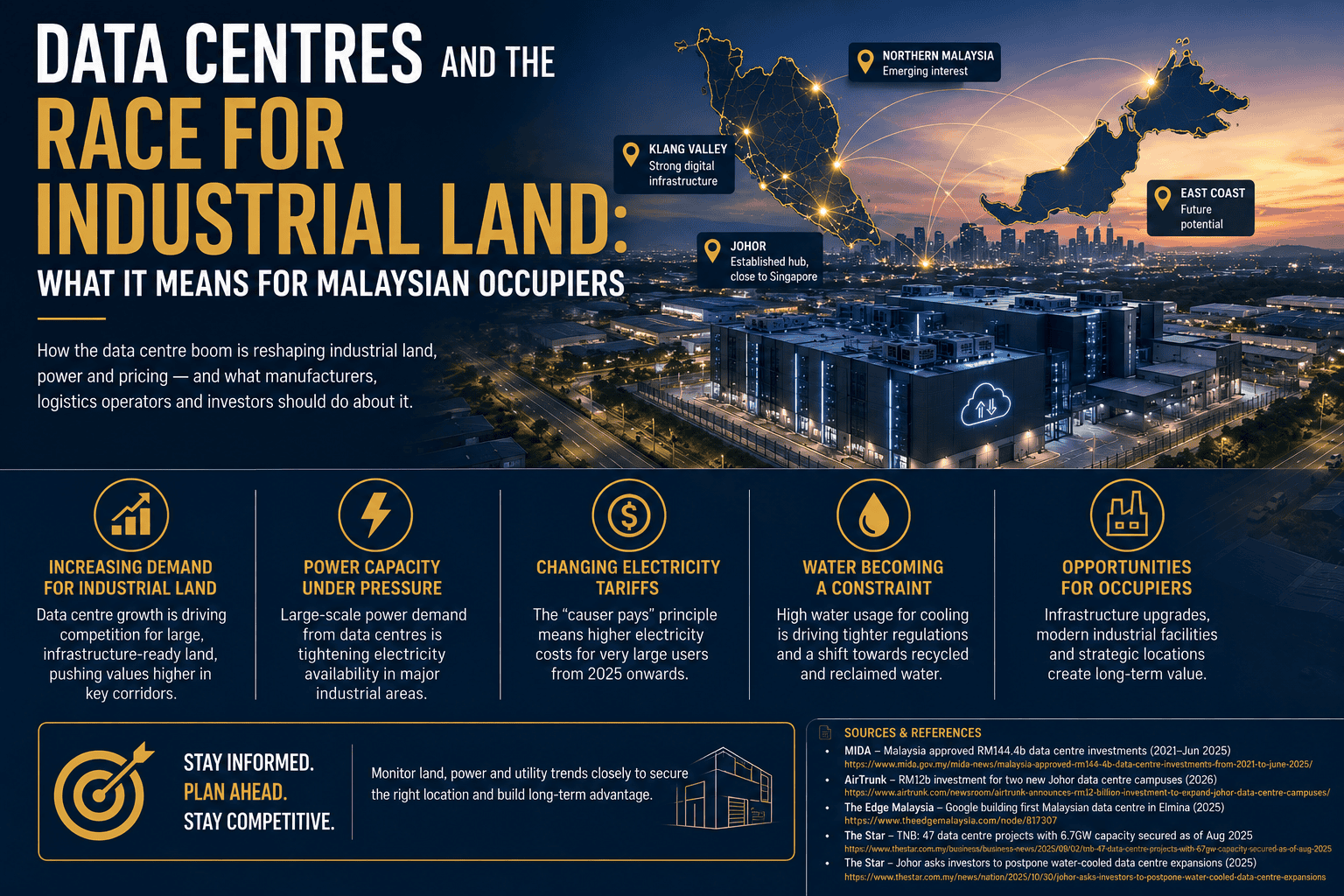
How the data centre boom is reshaping industrial land, power and pricing — and what manufacturers, logistics operators and investors should do about it.
Introduction
In a recent article, we looked at why power supply has quietly become one of the biggest factors in industrial property decisions. One major force accelerating that shift is the rapid growth of data centres.
Malaysia has become one of Southeast Asia’s fastest-growing destinations for data centres — the large facilities that support cloud computing, digital services and artificial intelligence.
Billions of ringgit are flowing into the sector, and while the headlines often focus on hyperscale campuses and global technology companies, the impact extends well beyond data centre operators themselves.
Manufacturers, logistics operators and industrial investors are increasingly facing the effects through industrial land demand, electricity availability, infrastructure requirements and property pricing.
Here is what is happening — and what it could mean for your next industrial property decision.
How Big Is the Data Centre Boom in Malaysia?
Malaysia’s data centre sector has expanded rapidly in recent years.
According to figures reported by the Ministry of Investment, Trade and Industry (MITI), approximately RM144.4 billion in data centre and cloud computing investments were approved between 2021 and June 2025. Read more about Malaysia’s data centre investment growth.
The rapid expansion has also placed greater attention on electricity demand. Data centres could account for a significantly larger share of Malaysia’s electricity consumption in the coming years, increasing the importance of grid capacity and energy planning. Read more about Malaysia’s data centre electricity demand and tariff changes.
Part of Malaysia’s growth was accelerated by developments in neighbouring Singapore.
Singapore introduced restrictions on new data centre developments between 2019 and 2022 because of concerns over land availability, electricity consumption and environmental sustainability. This encouraged some hyperscale operators to consider alternative locations in the region. White & Case explains how this helped accelerate Malaysia’s data centre boom.
Johor became a natural alternative because of its proximity to Singapore, availability of large industrial land parcels and expanding digital and utility infrastructure.
The scale of recent investment demonstrates how significant this trend has become.
In 2026, AirTrunk announced an additional RM12 billion investment to develop two data centre campuses in Iskandar Puteri, bringing its total committed investment in Malaysia to approximately RM27 billion. Read more about AirTrunk’s Malaysia expansion.
Google is also developing its first Malaysian data centre at Elmina Business Park in Selangor, demonstrating that large-scale investment is expanding beyond Johor. Read more about Google’s Malaysia data centre development.
Where is Data Centre Growth Happening in Malaysia?
Johor
Johor remains one of Malaysia’s most established data centre markets, particularly around:
• Iskandar Puteri
• Kulai
• Sedenak
Selangor
Selangor is also becoming increasingly important.
Areas around Cyberjaya, Sepang, Dengkil and Kuala Langat are attracting attention because of their connectivity, infrastructure and access to major economic corridors.
Selangor already has a significant and growing data centre presence, with further developments under construction and planned across the state, increasing demand for suitable land, electricity and supporting infrastructure.
Emerging Locations
Interest is gradually spreading beyond the established hubs.
Locations such as Serendah and Springhill in Negeri Sembilan have been identified as part of a potential second wave of data centre investment. Read more about Malaysia’s emerging data centre locations.
Northern Malaysia may also become increasingly relevant. Areas around Kulim Hi-Tech Park could benefit from their industrial ecosystem, infrastructure and comparatively lower land costs. Read more about Malaysia’s emerging northern data centre corridor.
For industrial occupiers, the important point is that many locations attracting data centre investment are also established or emerging industrial corridors.
This creates greater competition not only for land, but also for electricity, water and supporting infrastructure.
What It Means for Industrial Occupiers
1. Industrial Land Values Are Being Affected in Selected Corridors
Data centre operators typically require large parcels of industrial land with strong infrastructure, electricity capacity and connectivity.
That means they may compete for the same land sought by manufacturers, logistics operators, warehouses and industrial investors.
One notable example occurred in Banting, where approximately 136 acres of industrial land at IOI Industrial Park @ Banting were sold to Bridge Data Centres for RM740.68 million.
For occupiers looking to acquire industrial land in fast-growing corridors, historical transaction prices may therefore become less useful.
Buyers should consider:
- Current asking prices
- Recent comparable transactions
- Infrastructure development
- Utility capacity
- Future data centre or industrial developments nearby
In rapidly changing corridors, industrial land pricing can move much faster than businesses expect.
2. Power Availability Is Becoming Increasingly Important
Data centres require enormous amounts of electricity.
As Malaysia’s data centre pipeline expands, electricity availability is becoming an increasingly important consideration for industrial property users as well.
By late 2025, several gigawatts of data centre electricity demand had already been committed to Tenaga Nasional Berhad’s network. Bernama examines whether Malaysia’s electricity grid can support the rapid growth of data centres.
Malaysia has also introduced initiatives such as the Green Lane pathway to accelerate electricity connections for qualifying data centre projects. Read more about Malaysia’s grid connection initiatives.
This matters to manufacturers too.
A factory may appear suitable based on:
- Location
- Building size
- Ceiling height
- Loading capacity
- Highway accessibility
But if sufficient electricity cannot be delivered within the required timeframe, the property may not be operationally viable.
This is particularly important for:
- Heavy manufacturing
- Food processing
- Cold storage
- Metal fabrication
- Plastics manufacturing
- Automated production facilities
- High-capacity machinery operations
Power availability should therefore be checked before committing to an industrial property — not after signing the Sale and Purchase Agreement or tenancy agreement.
3. Electricity Tariffs Are Changing
Malaysia’s electricity tariff structure is also evolving as electricity-intensive industries increase pressure on the national grid.
Under the “causer pays” principle, very large electricity consumers may be expected to bear more of the infrastructure costs generated by their additional demand.
This approach has become particularly relevant to large data centres because some projects may require substantial upgrades to transmission and distribution infrastructure. Read more about Malaysia’s “causer pays” approach to data centre electricity demand.
Government statements have also indicated that infrastructure upgrade costs associated with major data centre developments should be borne by developers rather than transferred to ordinary consumers. Bernama provides further details on Malaysia’s electricity infrastructure strategy.
For industrial occupiers, the implication is straightforward:
Do not evaluate only whether electricity is available. Evaluate how much power you need, how quickly it can be supplied and what that electricity may cost over the life of your operations.
4. Water Is Becoming a Constraint Too
Electricity is not the only utility under pressure.
Large data centres using water-based cooling systems can consume significant quantities of water.
In Johor, concerns surrounding water consumption have already influenced how authorities evaluate certain data centre developments. In late 2025, the state reportedly asked investors to postpone some water-cooled expansions while encouraging greater use of recycled and reclaimed water. Read more about water constraints facing Malaysia’s data centre sector.
This is important for manufacturers because many industrial activities also depend heavily on reliable water supply.
Examples include:
- Food manufacturing
- Beverage production
- Semiconductor operations
- Chemical processing
- Metal treatment
- Cleaning and washing operations
- Cooling systems
For these businesses, industrial property due diligence increasingly needs to consider land, power and water together.
The Opportunities
The data centre boom does not only create pressure.
It can also create significant opportunities for industrial property owners, occupiers and investors.
Asset Appreciation
Industrial land located within or near fast-growing infrastructure corridors may experience stronger demand.
If you already own industrial property in one of these areas, rising land values may strengthen your asset position and potentially create refinancing or redevelopment opportunities.
Spillover Demand
Data centres create surrounding economic activity.
They require:
- Engineering contractors
- Maintenance companies
- Security providers
- Electrical specialists
- Equipment suppliers
- Logistics providers
- Technology vendors
- Facility management companies
These supporting businesses may require nearby factories, warehouses, offices and commercial premises.
As a result, industrial areas surrounding major data centre developments can benefit from broader demand.
Infrastructure Upgrades
Major data centre investments often encourage upgrades to:
- Electricity infrastructure
- Fibre connectivity
- Roads
- Utilities
- Supporting infrastructure
These improvements can ultimately benefit other businesses operating within the same industrial corridor.
A Wider Industrial Map
As established data centre corridors become more expensive or constrained, developers and occupiers may increasingly explore alternative locations.
This could create new opportunities in areas such as:
- Negeri Sembilan
- Serendah
- Northern Selangor
- Kulim
- Other emerging industrial corridors
For manufacturers and logistics businesses, these locations may offer a better balance between land price, infrastructure and future expansion capacity.
What Industrial Occupiers Should Do
Check Power Availability Early
Before committing to a factory, warehouse or industrial land parcel, confirm:
- Existing electricity supply
- Maximum available capacity
- Upgrade requirements
- Infrastructure costs
- Connection timeline
For power-intensive businesses, this should be one of the earliest stages of property due diligence.
Move Decisively on Suitable Land
Industrial land within strong infrastructure corridors can appreciate quickly.
If a property meets your operational requirements and commercial considerations, factor potential market movement into your decision-making rather than relying solely on historical prices.
Look Beyond the Obvious Corridors
Businesses do not necessarily need to compete directly with data centre operators for land in the most expensive locations.
Emerging industrial areas may provide:
- Lower land costs
- Larger available parcels
- Better expansion potential
- Greater electricity headroom
- Improving highway connectivity
Review Utilities Holistically
Industrial property selection should increasingly consider:
Land + Power + Water + Connectivity + Infrastructure
rather than land and building specifications alone.
If You Own Industrial Property, Reassess Its Position
An industrial asset acquired several years ago may now sit within a significantly more valuable corridor.
Owners should periodically reassess:
- Market value
- Surrounding developments
- Infrastructure upgrades
- Zoning potential
- Redevelopment opportunities
- Rental demand
The data centre boom may have changed the strategic value of your property without you realising it.