
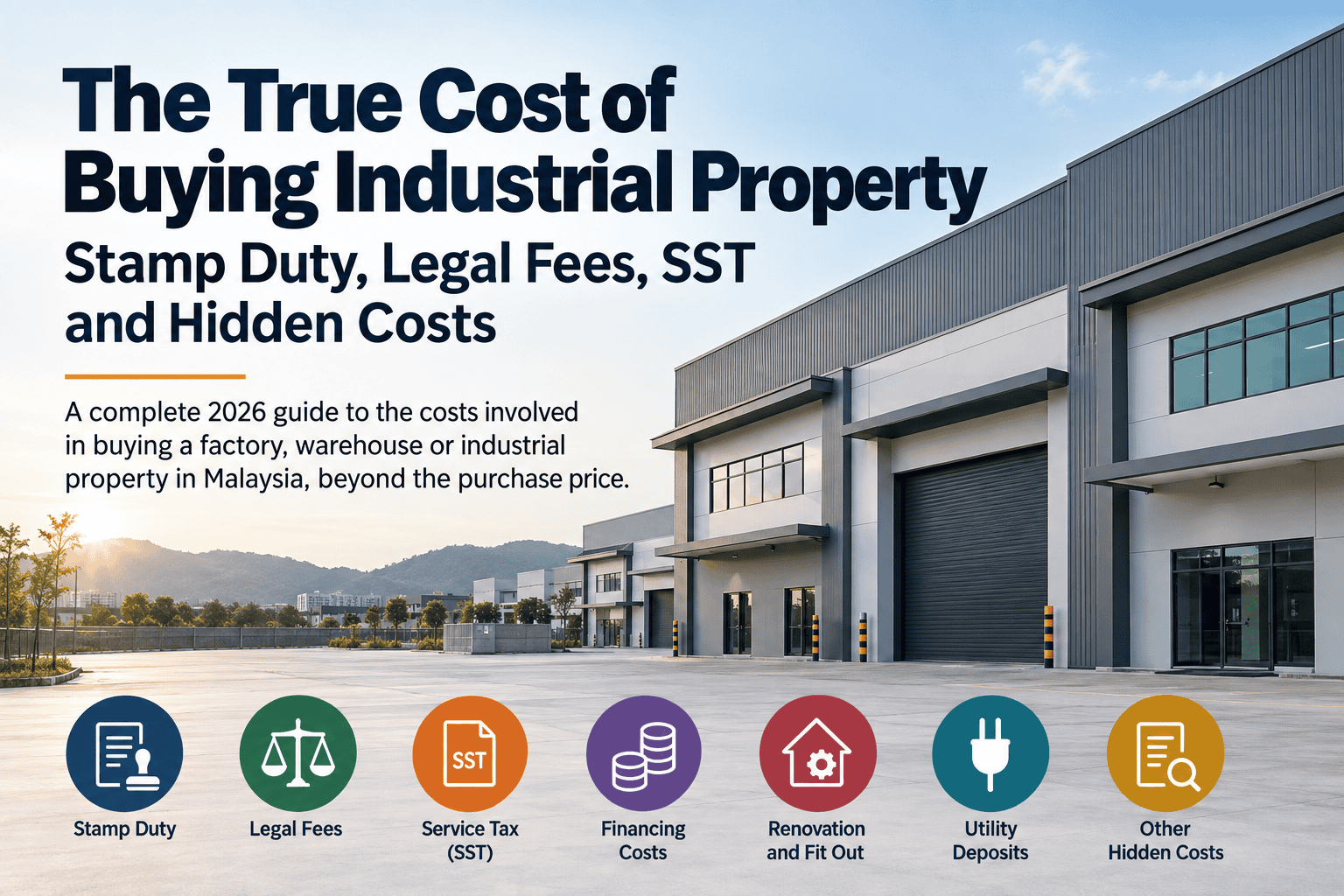
A complete 2026 guide to the costs involved in buying a factory, warehouse or industrial property in Malaysia, beyond the purchase price.
Introduction
When businesses budget for an industrial property purchase, most focus on one number: the purchase price.
But the price is only the beginning.
By the time a factory, warehouse or industrial property is transferred to the buyer, there may also be stamp duty, legal fees, Service Tax, financing costs, valuation fees, registration charges, utility deposits and other expenses.
For businesses buying industrial property in Malaysia, understanding these costs early is important because many of them need to be paid in cash and may not be covered by bank financing.
This guide explains the main costs involved in buying industrial property in Malaysia in 2026 and provides a worked example based on an RM1.5 million purchase.
If you are still evaluating a property, you may also want to read our Complete Guide to Buying Industrial Property in Malaysia (2026), which covers property type, tenure, zoning, infrastructure, title considerations and due diligence.
How Much Deposit Do You Need to Buy Industrial Property?
In many subsale transactions, buyers first pay an earnest deposit when the offer is accepted.
A common arrangement is approximately 2% to 3% at the offer stage, followed by the balance of the agreed deposit when the Sale and Purchase Agreement, or SPA, is signed.
A total deposit of around 10% of the purchase price is commonly seen, but this is a commercial arrangement rather than a fixed legal requirement. The actual amount depends on what the buyer and seller agree.
Financing for industrial property also varies significantly.
The amount a bank is prepared to finance depends on factors such as:
- The buyer’s financial profile
- Company financial performance
- Property type
- Property valuation
- Location
- Remaining lease tenure
- Intended use
- Bank lending policy
- Financing structure
Buyers should therefore obtain an indication of financing eligibility before committing to a purchase.
For the worked example in this article, we will assume an RM1.5 million industrial property with 80% financing, giving a loan amount of RM1.2 million and a 20% down payment of RM300,000 by the buyer.
This is an illustration only and should not be treated as the standard financing margin for all industrial properties.
How Is Stamp Duty Calculated When Buying Industrial Property?
One of the biggest acquisition costs is stamp duty on the instrument transferring the property.
Where an individual title has been issued, this commonly involves the prescribed transfer instrument. Different documentation may apply where an individual or separate title has not yet been issued.
For purchasers subject to Malaysia’s standard progressive property transfer rates, stamp duty is calculated on the higher of the purchase consideration or the property’s market value.
The standard rates are:
- 1% on the first RM100,000
- 2% on the next RM400,000
- 3% on the next RM500,000
- 4% on the amount above RM1,000,000
The rates are progressive. This means the highest rate is not applied to the entire property value.
Example: RM1.5 Million Industrial Property
First RM100,000 at 1% = RM1,000
Next RM400,000 at 2% = RM8,000
Next RM500,000 at 3% = RM15,000
Remaining RM500,000 at 4% = RM20,000
Total transfer stamp duty = RM44,000
Want to calculate the amount for a different property price? Use our Malaysia Property Calculator to estimate property stamp duty, legal fees, financing and total purchase costs.
How Much Are Legal Fees for Buying Industrial Property?
Legal fees for conveyancing transactions in Malaysia are regulated by the Solicitors’ Remuneration Order 2023.
Under Table A, the scale applicable to a standard sale and transfer includes:
- 1.25% on the first RM500,000
- 1% on the next amount up to RM7.5 million
For amounts exceeding RM7.5 million, different provisions apply.
A solicitor may give a discount of up to 25% on the applicable Table A fee.
This is important because the amount eventually quoted by the solicitor may be lower than the full prescribed scale used in the example below.
Are SPA and Loan Legal Fees Charged Separately?
Yes.
Where the buyer appoints solicitors to handle both the acquisition and financing, professional fees are generally calculated separately for:
- The SPA and property transfer work
- The financing and security documentation
This means a financed purchase can involve two separate sets of legal fees.
SPA Legal Fee Example
Purchase price: RM1,500,000
First RM500,000 at 1.25% = RM6,250
Next RM1,000,000 at 1% = RM10,000
Full scale professional fee = RM16,250
If 8% Service Tax applies to the solicitor’s taxable professional service:
Service Tax = RM1,300
Total = RM17,550
This example assumes the full Table A scale with no legal fee discount.
Loan Legal Fee Example
Loan amount: RM1,200,000
First RM500,000 at 1.25% = RM6,250
Next RM700,000 at 1% = RM7,000
Full scale professional fee = RM13,250
If 8% Service Tax applies:
Service Tax = RM1,060
Total = RM14,310
Again, this example assumes the full scale fee and no discount.
Is SST Charged on Legal Fees?
Legal services are among the professional services that can fall within Malaysia’s Service Tax framework.
The general Service Tax rate applicable to taxable professional services such as legal services is currently 8%, subject to the applicable registration and tax rules.
This is why buyers commonly see Service Tax added to the solicitor’s professional fee where applicable.
However, Service Tax should be distinguished from stamp duty and other statutory transaction charges.
Is SST Charged on the Industrial Property Purchase Price?
A common area of confusion is whether 8% SST should simply be added to the purchase price of an industrial property.
Generally, no.
The purchase price itself is not treated in the same way as a taxable professional service where 8% Service Tax is added to the service fee.
However, services connected with the transaction may separately attract Service Tax where applicable.
Examples can include:
- Legal services
- Valuation services
- Estate agency services
- Other taxable professional services
The tax treatment depends on the nature of the service and whether the service provider falls within the applicable SST framework.
What Are Legal Disbursements?
Legal professional fees are not the only amounts appearing on a solicitor’s bill.
There may also be statutory charges and disbursements incurred in completing the transaction.
Depending on the property and transaction, these may include:
- Land searches
- Company searches
- Bankruptcy or insolvency searches
- Registration charges
- Official extracts
- Caveat related charges
- State consent related charges
- Other transaction specific expenses
There is no reliable single figure that applies to every industrial property purchase.
Costs can differ according to the state, title, transaction structure, consent requirements and documentation involved.
Buyers should therefore ask their solicitor for an itemised quotation before committing to the purchase.
What Financing Costs Should Buyers Expect?
Financing can involve costs beyond loan stamp duty and legal fees.
Depending on the bank and financing package, these may include:
Valuation Fees
Banks commonly require an independent property valuation before finalising the financing amount.
The valuation is particularly important because the bank normally bases its financing decision partly on the property’s assessed value.
Bank Related Charges
Different lenders and financing facilities may impose different administrative or facility related charges.
Buyers should request a complete list of charges before accepting the financing offer.
Fire Insurance or Takaful
Where the property is used as security for financing, the lender may require appropriate insurance or takaful coverage over the building.
The premium depends on factors including the property value, building type, coverage and insurer.
Because these costs vary significantly, it is better to obtain actual quotations rather than rely on a general percentage.
What Other Costs Do Industrial Property Buyers Often Forget?
Industrial property purchases can involve several additional costs that may not appear in the initial purchase calculation.
Renovation and Fit Out
A factory or warehouse may require work before operations can begin.
Possible costs include:
- Office renovation
- Racking systems
- Mezzanine floors
- Machinery foundations
- Electrical upgrades
- Additional power supply
- Compressed air systems
- Ventilation
- Fire protection upgrades
- Cold room installation
- Loading equipment
- Security systems
For some industrial users, these costs can be substantial.
The cheapest property is therefore not necessarily the cheapest property to occupy.
Utility Deposits and Connection Costs
Buyers should check the requirements for electricity, water and other utilities.
The deposit or connection requirements depend on the utility provider, account structure and expected consumption.
Properties requiring major electrical upgrades may involve additional infrastructure and professional costs.
Quit Rent and Assessment
Industrial property owners generally need to account for ongoing property related charges such as:
Quit rent or cukai tanah, payable to the relevant land authority.
Assessment or cukai taksiran, payable to the relevant local authority.
During a subsale transaction, the SPA normally deals with the apportionment of relevant outgoings between seller and buyer.
Buyers should also ensure that outstanding amounts affecting the property are identified before completion.
State Authority Consent
Not every industrial property can be transferred immediately after an SPA is signed.
A title may contain a restriction in interest requiring State Authority consent before the property can be transferred or charged.
Foreign purchasers may also be subject to additional State Authority requirements.
Consent requirements can affect both transaction cost and completion time, so the title should be reviewed early.
Building and Operational Upgrades
Before purchasing a factory or warehouse, buyers should assess whether the property is actually suitable for the intended operation.
Possible additional costs may arise from:
- Fire safety upgrades
- Roof repair
- Floor strengthening
- Drainage improvement
- Loading area works
- Power upgrades
- Machinery installation
- Planning or licensing requirements
These are not technically acquisition taxes, but they can have a major effect on the true amount required to make the property operational.
Who Pays the Estate Agent’s Fee?
Under Malaysia’s regulated estate agency fee scale, the maximum fee for the sale or purchase of land and buildings is generally 3%, subject to the applicable rules and appointment.
Who pays the fee depends on who appointed the estate agent.
In a typical seller appointed marketing arrangement, the seller bears the estate agency fee.
However, a buyer who separately appoints an estate agent should confirm the fee arrangement under that appointment.
Service Tax may also apply to taxable estate agency services where applicable.
Why Can Stamp Duty Be Higher Than Expected?
Stamp duty on a property transfer is based on the purchase consideration or market value, whichever is higher.
This means negotiating a property below its assessed market value does not necessarily reduce the stamp duty proportionately.
For example, if a buyer agrees to purchase an industrial property for RM1.5 million but the relevant valuation for stamp duty purposes is RM1.7 million, the transfer duty may be assessed using RM1.7 million.
This is particularly important where there is a significant difference between the agreed purchase price and market value.
When Must Stamp Duty Be Paid?
Malaysia imposes prescribed time limits for stamping instruments.
For an instrument executed in Malaysia, an unstamped or insufficiently stamped instrument can generally be presented for stamping within 30 days of execution without attracting the late stamping penalty.
Late stamping can result in penalties, with the amount increasing according to the period of delay.
In practice, the solicitor handling the conveyancing normally manages the stamping process, but buyers should ensure sufficient funds are available when payment becomes due.
What Changed With Stamp Duty Administration in 2026?
Malaysia began implementing the Stamp Duty Self Assessment System, or STSDS, in phases from 1 January 2026.
Phase 1 in 2026 covers:
- Rental and lease instruments
- Securities
- General stamping
Phase 2 from 1 January 2027 covers specified transfers of real property without JPPH valuation.
Other instruments are included in later implementation phases.
This means it would be inaccurate to say that every industrial property transfer became fully subject to STSDS from the beginning of 2026.
Do Buyers Need to Think About RPGT?
Real Property Gains Tax, or RPGT, is primarily an exit consideration rather than an acquisition cost.
It may become relevant when the property is eventually sold.
RPGT is imposed on the chargeable gain arising from a disposal, subject to the applicable rules, permitted deductions and exemptions.
For a company incorporated in Malaysia, the RPGT rates currently include:
- Disposal within the first three years: 30%
- Disposal in the fourth year: 20%
- Disposal in the fifth year: 15%
- Disposal in the sixth year and thereafter: 10%
This differs from the treatment of individual Malaysian citizens, who currently have a 0% RPGT rate for disposals in the sixth year and thereafter.
Businesses acquiring industrial property as a long term investment should therefore consider eventual disposal tax when calculating overall investment returns.
Worked Example: RM1.5 Million Industrial Property
Assume:
Purchase price: RM1,500,000
Financing: 80%
Loan amount: RM1,200,000
Buyer equity contribution: RM300,000
Buyer is subject to the standard progressive property transfer stamp duty scale.
Legal fees are calculated at the full SRO 2023 Table A scale without discount.
8% Service Tax is assumed to apply to the legal professional fees.
Cost Item | Amount |
Transfer stamp duty | RM44,000 |
Loan or security stamp duty at 0.5% | RM6,000 |
SPA legal fee including assumed 8% Service Tax | RM17,550 |
Loan legal fee including assumed 8% Service Tax | RM14,310 |
Core calculated transaction costs | RM81,860 |
The buyer would therefore need:
RM300,000 equity contribution
plus
RM81,860 core calculated transaction costs
giving:
RM381,860
before taking into account other variable expenses.
These additional costs may include:
- Legal disbursements
- Registration fees
- Valuation fees
- Bank related charges
- Insurance or takaful
- State Authority consent related costs
- Utility deposits
- Renovation and fit out
- Operational upgrades
The actual amount required can therefore be significantly higher than RM381,860.
The example also assumes no discount on the prescribed legal fees. If the solicitor provides an allowable discount, the legal fee component may be lower.
How Should You Budget for an Industrial Property Purchase?
Instead of relying on one fixed percentage, build a transaction specific budget.
1. Calculate the Purchase Equity
Confirm the actual financing approved by the bank and determine how much of the purchase price must be funded in cash.
2. Calculate Transfer Stamp Duty
Use the applicable stamp duty rate based on buyer status and the higher of purchase price or assessed market value.
3. Obtain a Legal Fee Quotation
Ask for:
- SPA legal fees
- Financing legal fees
- Service Tax where applicable
- Estimated disbursements
- Registration charges
- Consent related costs
4. Ask the Bank for the Full Financing Cost
Confirm:
- Valuation fees
- Stamp duty
- Legal costs
- Insurance or takaful
- Other bank related charges
5. Budget for Operational Setup
For factories and warehouses, this can be one of the biggest hidden costs.
Inspect the property and estimate the cost of making it suitable for your actual operation.
What Is the True Cost of Buying Industrial Property in Malaysia?
The true cost is not simply the property price.
A buyer should consider:
Purchase price + equity requirement + stamp duty + legal fees + Service Tax on applicable services + financing expenses + registration and consent costs + utility deposits + fit out + operational upgrades.
For industrial property, the condition and specifications of the building can make the difference between a property that is genuinely good value and one that requires substantial additional investment after completion.
The key is to understand these costs before signing the SPA, not after.
A well planned industrial property purchase should consider not only what it costs to acquire the building, but also what it costs to finance, transfer, prepare, operate and eventually dispose of the property.
If you are currently evaluating an industrial property, you can continue with:
- Malaysia Property Calculator — estimate purchase costs based on your own figures.
- Complete Guide to Buying Industrial Property in Malaysia (2026) — understand the wider buying and due-diligence process.
- Factory For Sale vs Factory For Rent — compare buying with renting before committing capital.
- Types of Industrial Zoning in Malaysia and Why It Matters — understand whether a property is suitable for your intended industrial activity.
This article provides general information based on Malaysian rules and market practices applicable in 2026. Tax treatment, stamp duty, legal fees, financing terms and State Authority requirements may differ depending on the purchaser, property and transaction structure. Buyers should obtain transaction specific advice from their solicitor, tax adviser, banker and other relevant professionals before committing to a purchase.