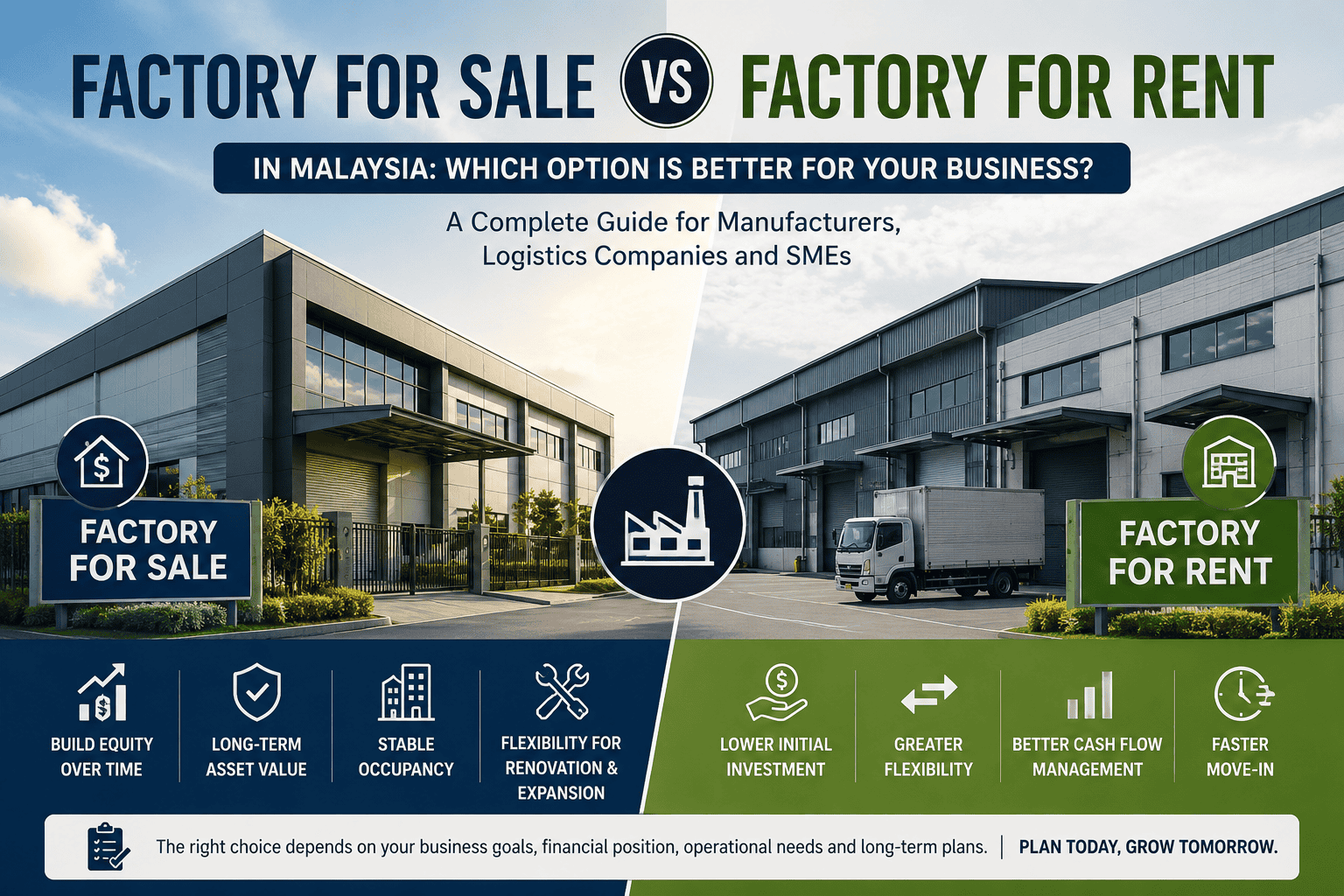
A Complete Guide for Manufacturers, Logistics Companies and SMEs.
Introduction
One of the biggest decisions businesses face when expanding operations is whether to buy a factory or rent one.
The right choice depends on your company’s financial position, business goals, operational requirements and long-term growth plans.
While buying offers ownership and long-term investment benefits, renting provides flexibility and lower upfront costs. There is no one-size-fits-all solution.
In this guide, we’ll compare both options to help you determine which approach best suits your business.
Buying vs Renting: What’s the Difference?
Buying a factory means owning the property and building equity over time. Renting allows businesses to occupy a factory without committing significant capital to property ownership.
| Factory for Sale | Factory for Rent |
|---|---|
| Property ownership | No ownership |
| Higher upfront investment | Lower upfront cost |
| Long-term asset appreciation | Greater flexibility |
| Suitable for long-term operations | Suitable for business expansion and shorter-term needs |
| Responsible for major property costs related to building | Landlord generally handles structural matters |
When Should You Buy a Factory?
Buying is generally suitable for businesses that:
• Have stable cash flow
• Plan to operate in the same location for many years
• Want to build long-term business assets
• Prefer ownership over rental commitments
• Have sufficient financing or capital
Who typically buys industrial property?
Typical buyers may include:
• Manufacturers and production companies
• Engineering and fabrication companies
• Food processing and cold chain businesses
• Plastic, packaging and chemical related industries
• Automotive and component suppliers
• Logistics, warehousing and distribution companies
• E-commerce and fulfilment operators
• Building material and furniture businesses
• Pharmaceutical and medical product companies
• Data, technology and specialised industrial operators
• Business owners looking for their own premises
• Industrial property investors and developers
The suitable buyer profile will depend on the property’s zoning, permitted use, power supply, building specifications, location and access.
Advantages of Buying?
• Build equity over time
• Potential capital appreciation
• Stable long-term occupancy
• Greater flexibility for renovations and expansion
• Better control over business operations
When Should You Rent a Factory?
Renting may be more suitable for businesses that:
• Are expanding quickly and need additional space
• Prefer lower upfront costs
• Need flexibility to relocate or upgrade
• Are testing a new market or business location
• Have limited capital for property purchase
• Want to preserve cash flow for operations and business growth
• Have short term or changing space requirements
• Are not ready to commit to long term property ownership
Who typically rents industrial property?
Typical industrial property tenants may include:
• Logistics and transportation companies
• Warehousing and distribution businesses
• E commerce and fulfilment operators
• Manufacturers and production companies
• Engineering and fabrication businesses
• Import and export companies
• Food processing and cold chain operators
• Automotive and parts suppliers
• Trading and wholesale businesses
• SMEs seeking space for operations, storage or expansion
The suitable tenant profile will depend on the property’s zoning, permitted use, location, power supply, building specifications and access for commercial vehicles.
Advantages of Renting an Industrial Property?
Renting may offer several advantages for businesses, including:
• Lower initial investment compared to purchasing
• Better cash flow management
• More capital available for machinery, inventory and business expansion
• Greater flexibility to relocate when operational needs change
• Easier upgrading to a larger or more suitable property
• Faster move in process, especially for ready built premises
• Less capital tied up in property ownership
• Lower exposure to property market fluctuations
• Fewer long term ownership commitments
Which Option Saves More Money?
There is no universal answer.
Buying involves:
• Down payment
• Legal fees
• Stamp duty
• Financing costs
• Maintenance
Renting involves:
• Rental payments
• Security deposit
• Tenancy agreement costs
• Periodic rental revisions
For businesses expecting rapid growth or facing uncertain expansion plans, renting may offer greater financial and operational flexibility. It allows a business to occupy a suitable industrial property without committing substantial capital to a purchase, while preserving cash flow for machinery, inventory and business expansion.
For businesses with stable long term operations and sufficient financial resources, property ownership may provide greater value and asset appreciation over time.
Before renting, tenants should carefully consider the rental rate, tenancy period, renewal terms, permitted use, power supply, building specifications and whether the property is suitable for their current and future operational needs.