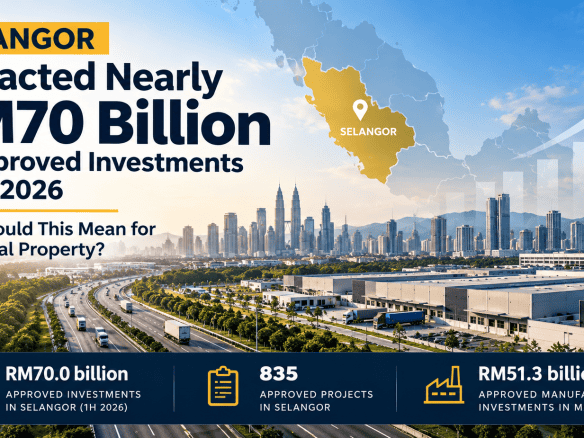

For many years, established industrial locations such as Shah Alam, Klang, Balakong and Kajang have been among the first choices for manufacturers, logistics operators and industrial investors.
These locations continue to benefit from mature infrastructure, established industrial ecosystems and excellent connectivity.
However, recent conversations with occupiers and investors suggest that another trend is emerging.
Rather than asking only, “Where is the best industrial location?”, businesses are increasingly asking, “Which location gives us the best balance between operational efficiency, future expansion and long term value?”
This shift is encouraging more companies to evaluate industrial corridors further south, including Semenyih, Beranang, Nilai and the surrounding areas.
Why Are Businesses Looking Further South?
Several factors appear to be influencing industrial location decisions.
1. More Space for Future Expansion
Many manufacturers are planning beyond their immediate operational needs.
Instead of acquiring just enough space for today’s production, businesses are looking for locations that provide room for future factory expansion, warehousing or additional production lines.
Southern industrial corridors generally offer larger land parcels compared with many mature industrial areas.
Highways such as LEKAS, PLUS, SKVE and the KLIA Expressway have significantly improved accessibility between Southern Klang Valley, Negeri Sembilan, Port Klang and Kuala Lumpur.
For many businesses, efficient transportation can be just as important as being located within a traditional industrial hub.
Companies may find opportunities to secure larger factories or industrial land within their available budgets, while maintaining good accessibility to customers, suppliers and logistics networks.
● Higher power supply options
● Better trailer accessibility
● Larger loading areas
● Higher ceiling heights
● More efficient factory layouts
These features can improve operational efficiency over the long term.
Does This Mean Established Industrial Hubs Are Losing Their Appeal?
Not at all.
Established locations such as Shah Alam, Klang, Balakong and Kajang continue to attract strong demand because of their mature supply chains, skilled workforce, supporting industries and proven business ecosystems.
For many businesses, these advantages remain difficult to replace.
Instead, businesses today simply have more viable location options than they did a decade ago.
Industrial location decisions are becoming increasingly strategic rather than purely location driven.
What Should Businesses Consider?
Every business has different operational requirements.
Before selecting an industrial property, businesses should evaluate:
- Highway connectivity
- Distance to suppliers and customers
- Power supply requirements
- Expansion potential
- Labour accessibility
- Logistics efficiency
- Long term operating costs
- Future business growth plans
The best industrial property is not necessarily the cheapest or the newest.
It is the one that best supports your business over the next five to ten years.
Our Take
The conversation around industrial property is changing.
Instead of focusing solely on traditional industrial hotspots, more businesses are evaluating how location, infrastructure, operational efficiency and future scalability work together.
Established industrial hubs will continue to play an important role in Malaysia’s industrial landscape.
At the same time, growing industrial corridors such as Semenyih, Beranang and Nilai are increasingly becoming part of the conversation for businesses planning their next phase of growth.
The real opportunity is not about choosing between north or south.
It is about choosing the location that gives your business the greatest long term operational advantage.