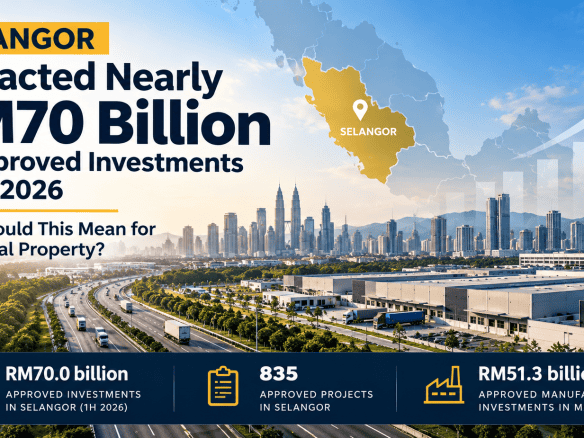

Malaysia’s manufacturing sector continues to play a significant role in driving the country’s economy. According to the latest data released by the Department of Statistics Malaysia (DOSM), industrial production remains active across several key sectors, reflecting continued business activity and industrial expansion.
For business owners, investors and manufacturers, this isn’t just an economic statistic—it provides valuable insight into the future demand for industrial properties, factories, warehouses and industrial land across Malaysia.
Why Manufacturing Growth Matters
When manufacturing activity increases, businesses typically require more operational space to support production, storage and distribution.
As companies expand, they may look for:
- Factories for production expansion
- Warehouses for inventory management
- Industrial land for future development
- Better logistics locations with highway connectivity
This creates opportunities not only for manufacturers but also for investors seeking industrial properties in strategic locations.
Industrial Areas That May Benefit
Several industrial corridors continue to attract strong interest due to their accessibility, infrastructure and established industrial ecosystem.
These include:
Kajang – Balakong Industrial Corridor
The Kajang–Balakong Industrial Corridor remains one of the Klang Valley’s most established manufacturing and logistics destinations. Excellent connectivity via the SILK Highway, Cheras–Kajang Expressway, LEKAS Highway and the Kajang Dispersal Link Expressway makes the corridor attractive to engineering, automotive, plastics, food processing and light manufacturing businesses.
With mature industrial parks, abundant supporting services and close proximity to Kuala Lumpur, Kajang–Balakong continues to be a preferred location for businesses looking to purchase or lease factories.
Semenyih – Seremban Industrial Corridor
Stretching from Semenyih through Beranang, Nilai, Bandar Enstek, Senawang and Seremban, this rapidly growing corridor has become one of Southern Klang Valley’s most promising industrial regions.
Excellent access via the LEKAS Highway, North–South Expressway (PLUS) and proximity to KLIA make the corridor particularly attractive for logistics operators, manufacturers, e-commerce fulfilment centres and export-oriented businesses seeking competitive industrial property prices and future growth potential.
Kepong – Rawang Industrial Corridor
The Kepong–Rawang Industrial Corridor serves northern Klang Valley and connects major industrial locations including Kepong, Segambut, Batu Caves, Selayang, Sungai Buloh, Kundang and Rawang.
Supported by highways such as LATAR, Guthrie Corridor Expressway, North–South Expressway and Jalan Kuching, the corridor continues to attract manufacturers, logistics companies, building material suppliers and heavy industrial operators requiring larger industrial facilities and good accessibility.
Puchong – Sunway Industrial Corridor
Puchong and Sunway remain highly sought-after industrial and commercial locations due to their strategic position within the Klang Valley.
With direct connectivity via the LDP, ELITE, SKVE, KESAS and MEX Expressways, this corridor supports businesses involved in distribution, light manufacturing, commercial operations, technology services and regional logistics. Its excellent accessibility makes it a preferred choice for companies serving the central Klang Valley market.
Shah Alam – Klang Industrial Corridor
The Shah Alam–Klang Industrial Corridor is one of Malaysia’s most mature industrial ecosystems and remains a key manufacturing hub for both domestic and multinational companies.
Its strategic location, comprehensive industrial infrastructure and close proximity to Port Klang, together with excellent connectivity through the KESAS, NKVE, Federal Highway and Guthrie Corridor Expressway, continue to attract businesses in automotive, food manufacturing, logistics, chemicals, engineering and export industries.
What Should Businesses Consider?
While manufacturing activity is encouraging, every business has different operational requirements.
Before purchasing or renting an industrial property, businesses should evaluate factors such as:
- Location and accessibility
- Highway connectivity
- Land tenure (Freehold or Leasehold)
- Power supply requirements
- Ceiling height
- Floor loading
- Loading bay configuration
- Future expansion opportunities
- Restriction in Interest requirements
- Availability of skilled workforce
Selecting the right property involves more than just price—it should align with your operational needs and long-term business plans.
Looking Ahead
Malaysia’s continued industrial activity reflects the resilience of the manufacturing sector and reinforces the importance of well-located industrial properties.
Although economic conditions may fluctuate, businesses that plan ahead and secure suitable industrial facilities in strategic locations are often better positioned to support future growth.
Whether you are looking to purchase a factory, lease a warehouse or invest in industrial land, understanding broader economic trends can help you make more informed property decisions.
Source
Data referenced from the Department of Statistics Malaysia (DOSM) through the Index of Industrial Production March 2026 release. This article provides BusinessProperty.com.my’s own analysis and commentary on how manufacturing trends may influence industrial property demand; it is not a reproduction of the DOSM publication.