Choosing the right factory or warehouse is not simply about finding the biggest property within your budget.
Too little space can restrict operations and future growth, while too much space may mean paying for areas your business does not actually use.
The right size depends on how your business operates, stores goods and plans to grow.
Start With Your Actual Operations
Before deciding that you need a 10,000, 20,000 or 50,000 sq ft property, consider how the space will actually be used.
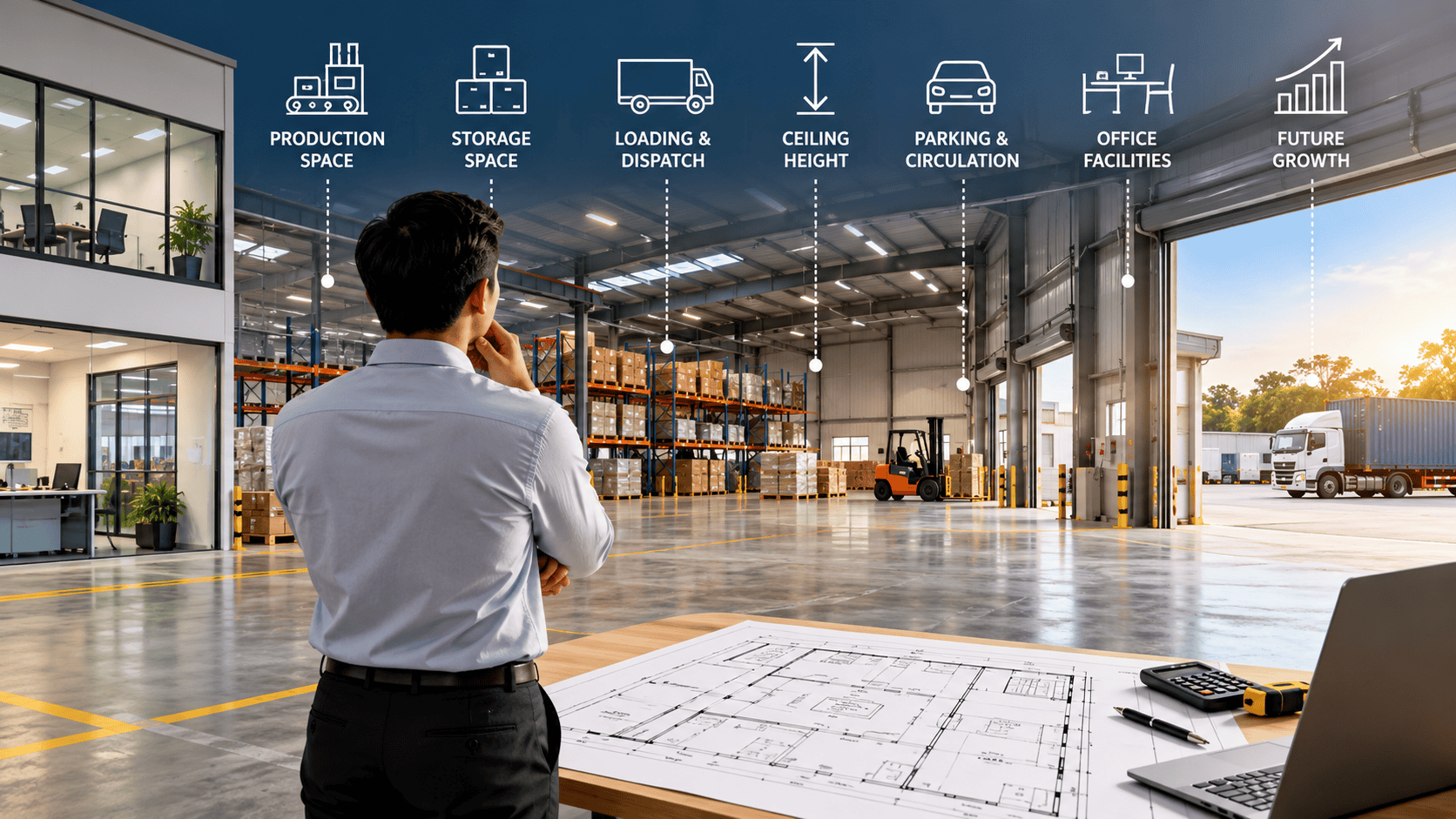
Typical requirements may include:
- Production or assembly
- Raw material storage
- Finished goods storage
- Packing and dispatch
- Office and staff facilities
- Loading and unloading
- Parking and vehicle movement
A manufacturer, for example, may require significant production space for machinery. A distributor may need less production area but considerably more warehouse and loading space.
Understanding this breakdown helps businesses search for properties based on operational needs rather than size alone.
Built-Up Area Isn’t the Whole Story
Industrial property listings commonly show both land area and built-up area.
Built-up area tells you how much constructed floor space is available, but the surrounding land can be equally important.
Businesses receiving regular truck or container deliveries may need sufficient external space for vehicle access, turning, loading and parking.
A larger factory building with very limited external space may therefore be less practical than a slightly smaller building with better circulation.
For Warehouses, Look Up — Not Just Across
Warehouse users should also consider ceiling height and storage configuration.
Two warehouses with the same floor area may provide very different storage capacity if one allows significantly taller racking.
Other practical considerations include:
- Column spacing
- Floor loading
- Loading bays
- Roller shutter access
- Forklift movement
- Truck and container accessibility
This is why comparing warehouses purely by square footage can sometimes be misleading.
Consider How Materials Move
For manufacturing businesses, layout can be just as important as overall size.
A typical operational flow could be:
Receiving → Raw Materials → Production → Packing → Finished Goods → Dispatch
If workers, forklifts and materials constantly need to move backwards and forwards across the building, a larger property may still operate inefficiently.
When viewing a factory, imagine the actual movement of goods through the premises rather than looking only at empty floor space.
Allow for Growth — Within Reason
Businesses should also consider where they expect to be over the next few years.
Will you add machinery or another production line?
Will inventory increase?
Will you employ more people?
Will you introduce additional products?
Having some spare capacity can reduce the need to relocate again when the business expands.
However, there is a balance.
Taking substantially more space based purely on optimistic growth projections can create unnecessary rental, financing and maintenance costs.
The goal should be reasonable expansion capacity, not simply the largest property available.
A Simple Checklist Before You Search
Before arranging factory or warehouse viewings, determine:
Minimum built-up area — How much usable indoor space do you actually need?
Land requirement — Do you need a large yard, parking or container access?
Ceiling height — Is vertical storage important?
Loading requirements — How many trucks or containers may arrive at once?
Office requirement — How much administrative space is genuinely necessary?
Future growth — What additional capacity could realistically be required?
Giving these requirements to your property agent can also help narrow the search to properties that genuinely suit your operations.
The Right Space Matters More Than the Biggest Space
A 30,000 sq ft factory is not automatically better than a 20,000 sq ft factory.
Building layout, ceiling height, loading areas, external circulation and usable operational space can make a significant difference.
When choosing a factory or warehouse, consider how effectively the property supports your business today and whether it provides reasonable room for tomorrow.
The objective isn’t to find the biggest industrial property.
It’s to find the right space for the way your business works.