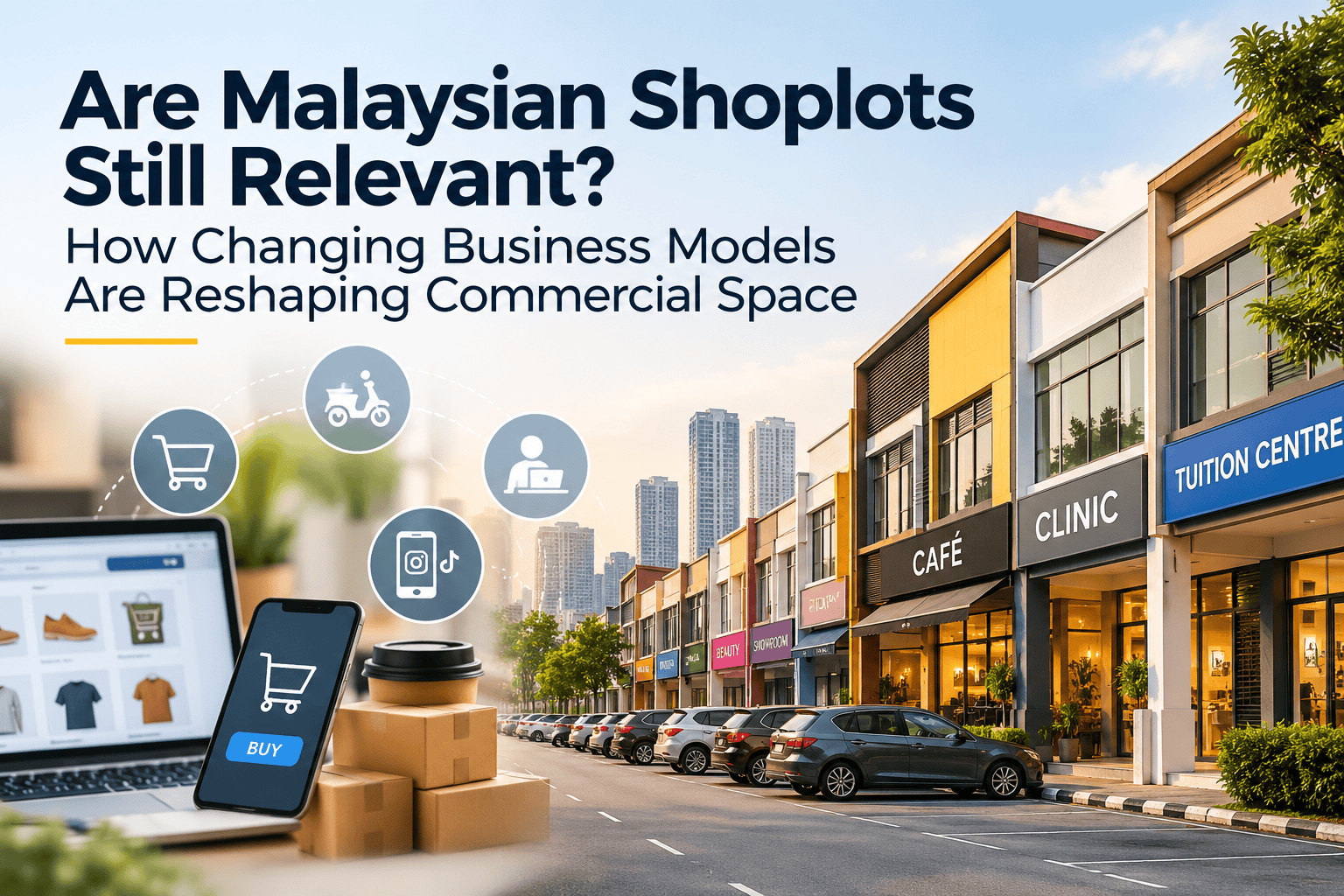
Online shopping, food delivery, remote work and social media have changed how Malaysian businesses reach their customers.
For some businesses, having a physical storefront is no longer as important as it once was. Yet drive around established commercial areas in Puchong, Subang Jaya, Petaling Jaya, Kajang or Shah Alam, and shoplots remain an important part of the business landscape.
So, are shoplots becoming less relevant — or are businesses simply using commercial space differently?
Recent market data suggests that physical commercial space remains relevant, but businesses are becoming more selective about the type of space and location they occupy.
Malaysia’s Retail Market Is Still Growing
Despite the growth of e-commerce, Malaysia’s physical retail sector continues to record activity.
According to Knight Frank’s Real Estate Highlights 1H 2026, Malaysian retail sales grew 3.7% year-on-year in the first quarter of 2026, supported by festive spending, government assistance and tourism.
Within Klang Valley alone, Knight Frank estimates approximately 74 million sq ft of existing retail space, with another 2.2 million sq ft expected in the second half of 2026.
Source: Selective demand drives narrowing market in 1H2026
This does not mean every retail location will perform equally well. Instead, the market is increasingly differentiated by location, customer profile and the type of experience a property can support.
Why Physical Space Still Matters
E-commerce works extremely well for products that can be selected and delivered without much physical interaction.
But many businesses cannot operate entirely online.
Consider businesses such as:
- Restaurants and cafés
- Clinics and dental practices
- Beauty and wellness centres
- Tuition and education centres
- Fitness studios
- Automotive businesses
- Showrooms
- Convenience retailers
- Professional and specialised services
For these businesses, physical premises remain part of the product or service itself.
A customer may discover a restaurant through TikTok or find a clinic through Google, but the actual transaction or service still takes place at a physical location.
Digital channels therefore do not necessarily replace commercial property. In many cases, they simply change how customers discover and choose businesses occupying those properties.
Shoplots Are Becoming More Than Traditional Retail
Traditionally, the value of a shoplot was strongly associated with walk-in traffic.
Today, that relationship can be more complicated.
A restaurant may generate significant orders through delivery platforms. A beauty business may operate primarily through appointments generated from Instagram. A showroom may attract customers who researched the product online before visiting.
This means some businesses no longer need the busiest pedestrian location.
Instead, they may prioritise:
Accessibility, parking, visibility, surrounding population and reasonable occupancy costs.
For certain businesses, a slightly less prominent shoplot with convenient parking and easy road access may work better than an expensive high-traffic location.
Commercial Property Is Becoming More Location-Specific
Malaysia’s commercial property market is large and varied.
NAPIC’s latest publication catalogue includes dedicated H1 2026 reports on commercial-building occupancy, property stock, rental indices and regional property-market performance, reflecting the importance of looking at individual property segments and locations rather than treating “commercial property” as one market.
Source: NAPIC – Latest Property Market Publications
The same principle applies when evaluating a shoplot.
A shoplot surrounded by established residential neighbourhoods may suit F&B, clinics, education and everyday services.
A unit near an industrial area may attract businesses serving factories and employees.
Commercial areas close to major highways may work well for destination businesses whose customers primarily arrive by car.
The question is therefore becoming less about whether shoplots in general are attractive and more about whether a specific shoplot serves the right catchment and business type.
Even Offices Are Seeing More Selective Demand
The trend towards selectivity is also visible in the Klang Valley office market.
Knight Frank reported office occupancy of approximately 88.6% in the KL Fringe, 72.5% in KL City and 73.9% in Selangor during 1H 2026.
These differences demonstrate why broad statements about the commercial property market can be misleading.
Location, building quality, accessibility and the needs of occupiers increasingly influence how individual properties perform.
Source: Selective demand drives narrowing market in 1H2026
What Should Businesses Look for in a Shoplot Today?
For businesses considering a shoplot, high traffic alone should not determine the decision.
Consider:
Customer catchment — Are your target customers living or working nearby?
Accessibility — Can customers reach the property easily?
Parking — Is visiting the business convenient?
Visibility — Does your business actually depend on being seen from the road?
Surrounding businesses — Do neighbouring businesses attract a compatible customer base?
Digital acquisition — If most customers find you online, are you paying unnecessarily for premium foot traffic?
Operating costs — Can the location generate enough business to justify its occupancy cost?
Different businesses will answer these questions differently.
Shoplots Aren’t Disappearing — Their Role Is Changing
Digital commerce has undoubtedly changed how businesses use physical property.
But that does not necessarily make shoplots obsolete.
Instead, the relationship between online discovery and offline business is becoming more important.
Customers may discover a business on TikTok, compare it on Google, contact it through WhatsApp and then travel to the physical premises.
For property owners, investors and businesses, this means the value of a commercial property increasingly depends on how well it supports the businesses that actually operate there.
Rather than asking whether Malaysian shoplots are still relevant, a better question may be:
Which locations and types of shoplots remain relevant to the way businesses and customers behave today?