Selangor continues to strengthen its position as one of Malaysia’s key business and investment destinations.
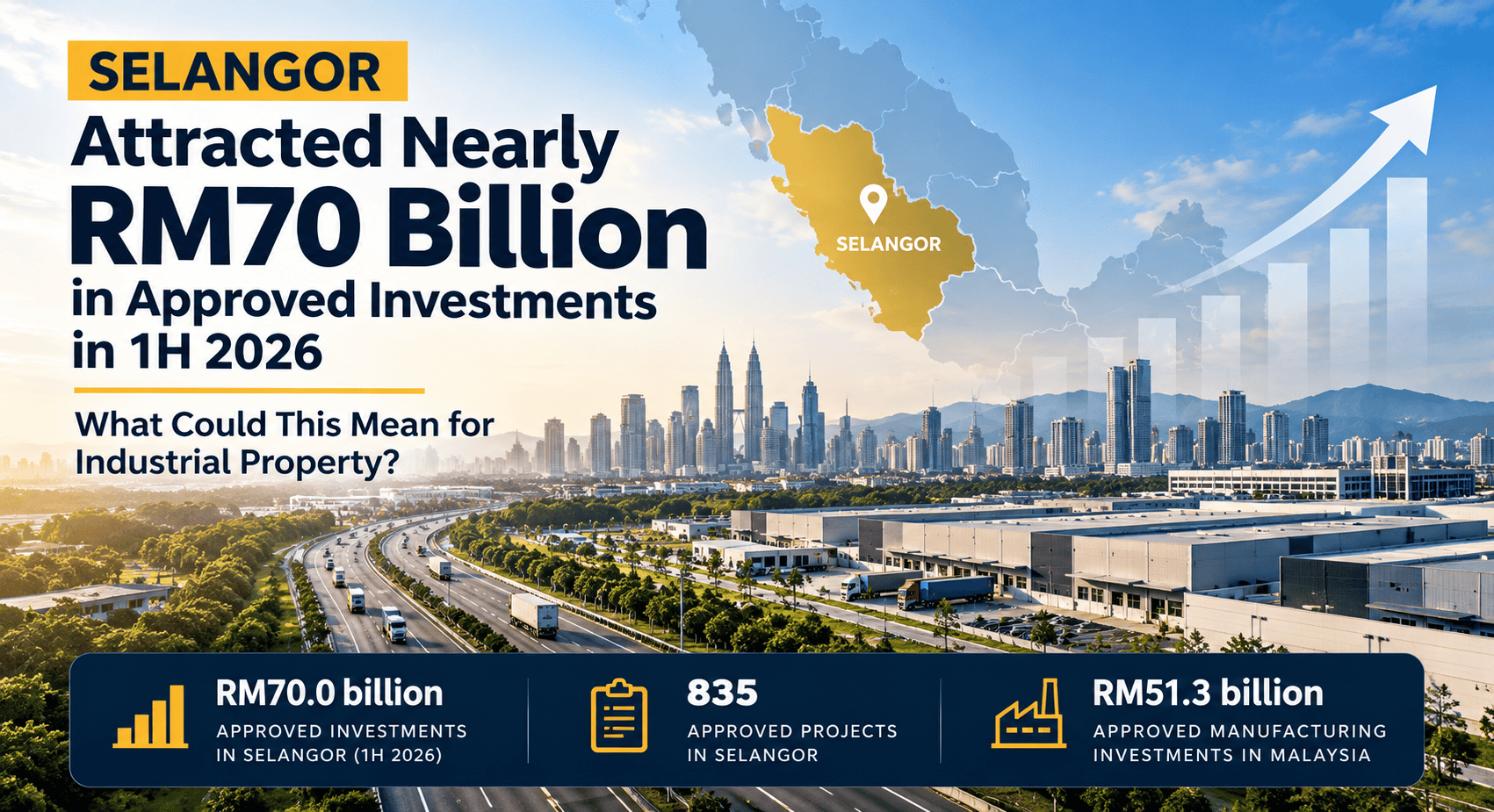
According to the Malaysian Investment Development Authority (MIDA), Selangor recorded RM70.0 billion in approved investments across 835 projects during the first half of 2026, making it the leading investment destination in Malaysia by investment value.
Across Malaysia, total approved investments reached RM218.5 billion in 1H 2026, an increase of 11.7% year-on-year.
Source: MIDA – Malaysia Secures RM218.5 Billion in Approved Investments in 1H 2026
While approved investments do not translate directly into property transactions, the figures provide useful insight into the level of business activity that could influence future requirements for factories, warehouses and industrial land.
Selangor Leads Malaysia’s Investment Destinations
In the first six months of 2026, the five leading states and territories by approved investment value were:
Location | Approved Investments |
Selangor | RM70.0 billion |
Johor | RM59.4 billion |
Kuala Lumpur | RM26.6 billion |
Penang | RM20.2 billion |
Sarawak | RM10.8 billion |
Selangor also recorded 835 approved projects, the highest number among the leading investment destinations reported by MIDA.
The RM70 billion figure covers investments across different sectors, so it should not be interpreted as RM70 billion flowing specifically into industrial property or manufacturing.
However, Malaysia’s manufacturing investment figures provide another useful indication of potential future industrial activity.
Manufacturing Project Numbers Increased
Malaysia recorded RM51.3 billion in approved manufacturing investments across 973 projects during 1H 2026.
An interesting point is the number of projects involved. According to MIDA, the number of approved manufacturing projects increased by 88.2% compared with the same period in 2025.
The manufacturing investment value was also almost evenly divided between new operations and existing businesses expanding or diversifying:
RM25.8 billion (50.3%) came from new projects, while RM25.5 billion (49.7%) came from expansion and diversification projects.
This is particularly relevant when looking at industrial property.
A new manufacturing operation may require industrial land, a ready-built factory or a purpose-built facility. An existing company expanding its operations may instead look for a larger factory, additional warehouse space or another location close to its existing operations.
From Investment Approval to Actual Operations
It is important to distinguish approved investment from completed projects.
An investment approval does not necessarily mean a new factory will immediately begin operating.
According to MIDA, as of 18 August 2026, 87% of manufacturing projects approved between 2021 and June 2026 had reached various stages of implementation, including projects already in production, under construction or progressing towards implementation. MIDA notes that manufacturing projects typically have an 18-to-24-month development cycle, depending on complexity.
This means today’s investment figures can also provide some indication of business activity that may materialise over the coming years.
What Could This Mean for Industrial Property?
As companies establish new operations or expand existing ones, their property requirements can vary considerably.
Some businesses may require large industrial land parcels for purpose-built facilities. Others may prefer existing detached or semi-detached factories that allow operations to begin sooner.
Warehousing and logistics requirements may also increase alongside manufacturing activity, particularly where businesses need additional space for raw materials, finished goods and distribution.
However, location alone is not enough.
Businesses evaluating industrial properties increasingly need to consider factors such as:
- Highway and logistics connectivity
- Factory specifications and layout
- Truck and container accessibility
- Power requirements
- Workforce availability
- Proximity to suppliers and customers
- Availability of suitable industrial land or buildings
These factors can influence which industrial areas are suitable for different types of operations.
Selangor’s Established Industrial Areas Remain Relevant
Selangor has several established and developing industrial corridors serving different business requirements.
Areas such as Shah Alam–Klang and Puchong–Sunway provide access to mature industrial and commercial ecosystems, while Kajang–Balakong and Semenyih–Beranang provide businesses with alternative locations towards the southern part of the Klang Valley.
Companies considering locations further south may also evaluate Nilai and Seremban in Negeri Sembilan, depending on their operational requirements, workforce, logistics routes and budget.
The right location ultimately depends on the individual business rather than investment statistics alone.
Looking Beyond the RM70 Billion Headline
Selangor attracting RM70 billion in approved investments is a significant headline, but the broader numbers may be equally important for the industrial property market.
Malaysia approved 973 manufacturing projects within the first six months of 2026, while almost half of manufacturing investment value came from companies expanding or diversifying existing operations.
These figures do not guarantee an immediate increase in industrial property demand or property values.
What they do show is continued investment activity involving both new businesses and existing companies expanding their operations.
For industrial property owners, investors and businesses searching for factories, warehouses or industrial land, monitoring investment trends alongside infrastructure development, transaction activity and local property supply can provide a clearer picture of how Malaysia’s industrial landscape is evolving.
Source / Further Reading