Businesses searching for a factory for sale or factory for rent in Malaysia are looking beyond location, size and price.
For manufacturers, warehouse operators and growing SMEs, the bigger question is increasingly:
“Can this factory actually support our operation?”
A property may be in a good industrial location and offered at an attractive price, but if the specifications do not match the business, it may quickly fall off the shortlist.
So, what are businesses actually looking for when choosing a factory today?
1. Does the Factory Have Enough Power?
Power supply can be one of the most important requirements for manufacturing operations.
Industries such as engineering, metal fabrication, food processing, plastics and machinery based manufacturing may require significantly more electricity than a conventional warehouse operation.
Businesses should consider both their current requirement and future expansion.
A factory with sufficient power today may become restrictive if additional production lines or machinery are introduced later.
However, higher power does not automatically make a factory better.
The right power capacity depends on the operation.
2. Can Containers and Heavy Vehicles Move Easily?
For many industrial occupiers, accessibility means more than being close to a highway.
Businesses need to consider whether containers, trailers and heavy vehicles can actually enter, manoeuvre, load and exit efficiently.
Road width, factory entrance, turning radius, loading areas and yard space can all affect daily operations.
A well located factory with difficult heavy vehicle access may be less practical than a property slightly further away with a better industrial layout.
3. Are the Factory Specifications Suitable?
Different businesses require very different buildings.
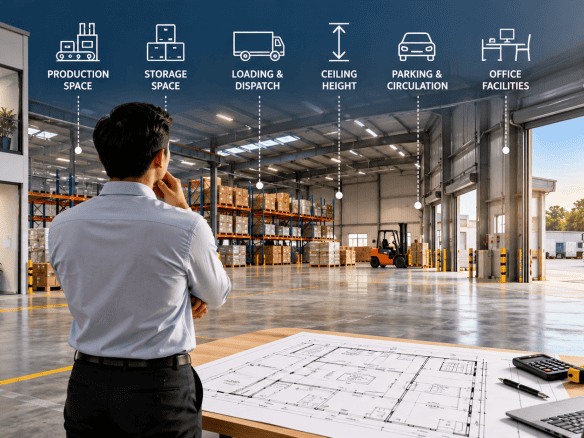
Manufacturers may evaluate ceiling height, floor loading, production layout, power supply and machinery space.
Warehouse operators may place greater importance on clear height, loading efficiency, storage configuration and vehicle movement.
Other businesses may need a larger office component, additional parking or outdoor storage.
This is why built up area alone does not tell businesses whether a factory is suitable.
How the space can be used is often more important than how much space there is.
4. Is There Enough Usable Land?
Land area can significantly affect industrial usability.
Businesses may require compound space for:
- Container movement
• Loading and unloading
• Employee parking
• Outdoor storage
• Machinery or equipment
• Future building extension
A factory with a large built up area but very little remaining compound may not suit a business with frequent container movements.
Conversely, a property with a smaller building but a practical yard may work much better for certain operations.
Businesses should therefore evaluate usable land, not simply total land area.
5. Can the Business Expand Without Moving Again?
Relocating a manufacturing operation can be expensive and disruptive.
Machinery may need to be dismantled and reinstalled. Production can be interrupted. Licences, utilities and operational approvals may also need to be addressed.
This is why businesses planning long term growth increasingly consider future expansion potential when searching for industrial property.
Additional land, sufficient power capacity or a flexible building layout may allow a company to grow without relocating again several years later.
The right factory should ideally support not only today’s operation, but also tomorrow’s growth.
6. Is the Industrial Use Suitable?
A factory building does not automatically mean every type of business can operate there.
Before buying or renting, businesses should understand the property’s planning zoning, permitted industrial use and relevant restrictions.
Different manufacturing activities can have different requirements, particularly between light, medium and heavy industries.
This is especially important for operations involving higher environmental impact, machinery, emissions, storage or specialised manufacturing processes.
The property must suit both the physical operation and the applicable planning requirements.
7. Can the Business Find and Retain Workers?
Workforce accessibility is sometimes overlooked during a factory search.
A property may be excellent for logistics but difficult for employees to reach.
Businesses should consider where their workforce lives, public transportation availability where relevant, road congestion and travelling time.
For labour intensive manufacturing operations, workforce accessibility can become an important factor in deciding between industrial locations.
This is one reason different businesses may evaluate Shah Alam, Klang, Balakong, Kajang, Semenyih, Beranang or Nilai very differently.
The best location depends on the operation and the people required to run it.
8. Does the Location Fit the Supply Chain?
Industrial location decisions are increasingly about the entire operational network.
A business should consider its relationship with customers, suppliers, highways, ports, airports and distribution markets.
For an import and export business, access towards Port Klang may be critical.
For another company serving southern Klang Valley or Negeri Sembilan, locations around Kajang, Semenyih, Beranang or Nilai may make more operational sense.
There is no single best industrial location in Malaysia.
There is only the location that best supports the business.
Is Price Still Important?
Of course.
Rental and purchase price remain major considerations when businesses compare a factory for rent or factory for sale in Malaysia.
But the cheapest factory is not necessarily the lowest cost factory to operate.
A business may save on rent but spend more on transportation, upgrading, electricity infrastructure or inefficient operations.
This is why businesses should consider total operational cost, rather than property price alone.
What Should Businesses Check During a Factory Viewing?
A factory viewing should go beyond inspecting the building.
Businesses should observe how trucks enter the property, measure usable production and storage space, understand the existing power supply, inspect loading areas and consider how machinery or racking will be arranged.
They should also evaluate surrounding roads, neighbouring activities and potential expansion areas.
The purpose of a factory viewing is not simply to ask:
“Do we like this property?”
It is to determine:
“Can our business operate efficiently from here?”
Our Take
Businesses searching for industrial property in Malaysia are becoming more operationally focused.
Location and price still matter, but they are only part of the decision.
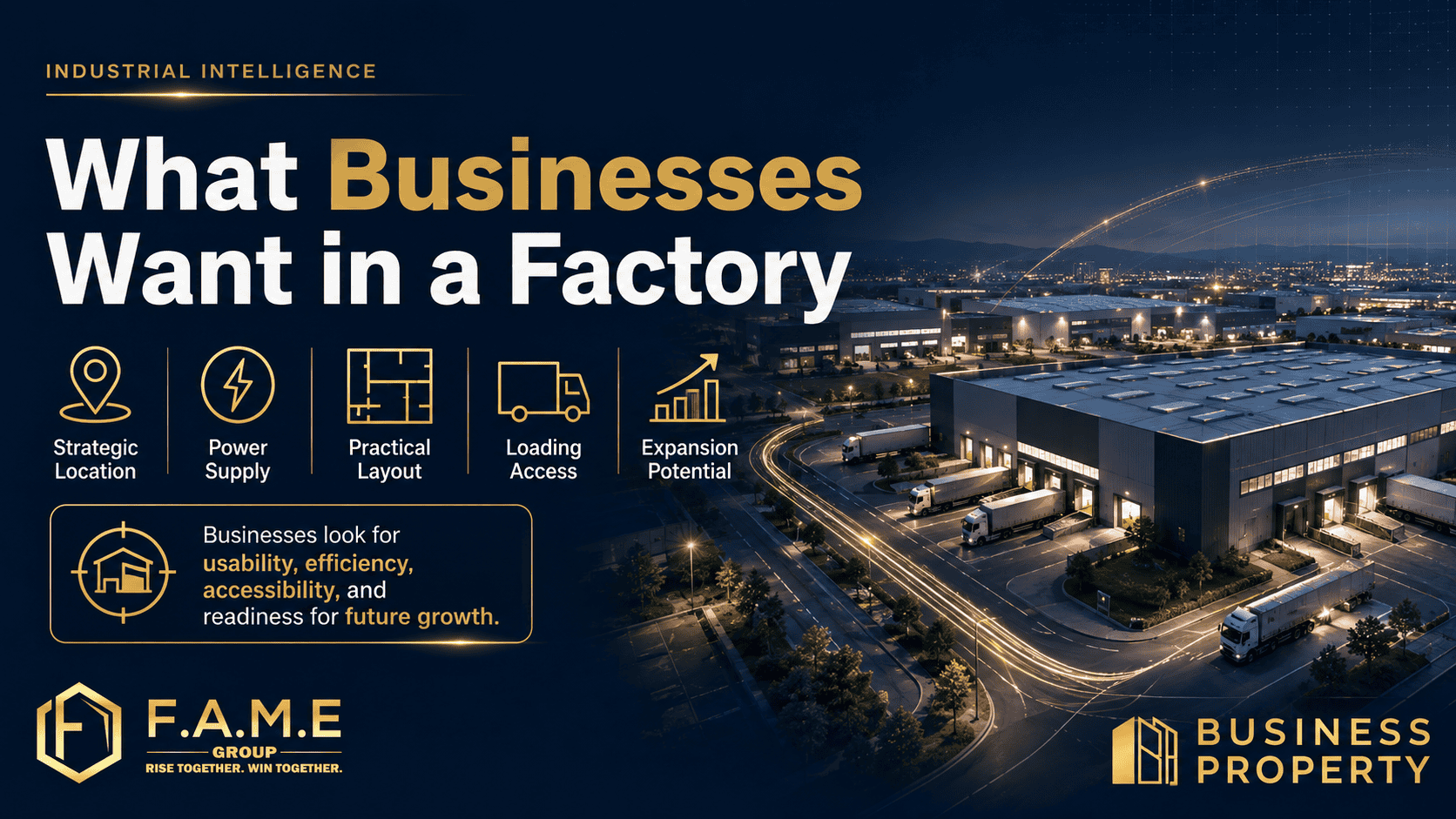
Power supply, factory specifications, container access, usable land, expansion potential, permitted use, workforce and supply chain connectivity can all influence whether a property makes the shortlist.
For factory owners and industrial property investors, understanding these requirements is equally important.
A property that works well for businesses is more likely to remain relevant to future occupiers.
Ultimately, the best factory is not necessarily the biggest, newest or cheapest.
It is the factory that allows the business to operate efficiently today and grow tomorrow.